Moving the Point
A road sign says the next town is 2.5 km away. Your friend asks: "How many metres is that?" With older units this would mean some careful sums. With metric units you can answer in a second. How?
Multiplying by ten is moving the point
In the Kilo, Centi, Milli lesson we saw that every metric step is 10, 100 or 1,000. Multiplying by these numbers is easy:
- times 10: move the point one place to the right;
- times 100: move the point two places;
- times 1,000: move the point three places.
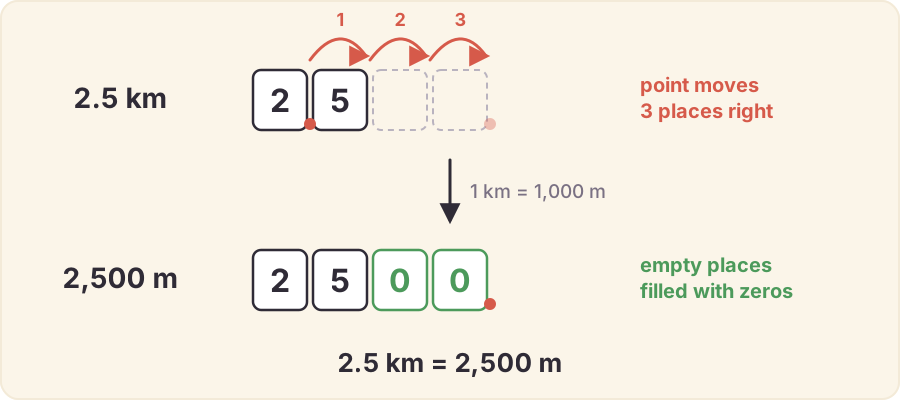
When there are no more digits, write zeros. So 2.5 times 1,000: move the point three places to the right, filling the empty places with zeros, and you get 2,500.
A kilometre is 1,000 metres, so 2.5 km = 2,500 m.
Which way does the point go?
In the A Number and a Unit lesson we saw that a smaller unit gives a bigger number. That tells you which way to move:
- to a smaller unit (km to m, m to cm): the number gets bigger, so the point moves to the right;
- to a bigger unit (mm to cm, cm to m): the number gets smaller, so the point moves to the left.
A pencil is 150 mm long. Going to centimetres, a bigger unit, the number gets smaller: 10 mm make a centimetre, so move the point one place left. 150 mm = 15 cm.
A door is 210 cm tall. 100 cm make a metre, so move the point two places left. 210 cm = 2.1 m.
The staircase
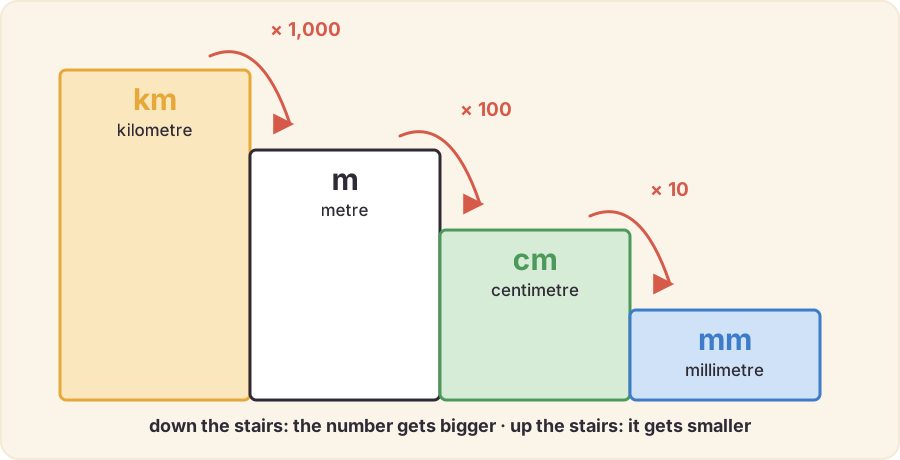
Here are the steps between the lengths you know. Going down the stairs, to a smaller unit, the point moves right. Going up, to a bigger unit, it moves left.
Try it at home
- Measure a book in millimetres. Now write the same length in centimetres by moving the point one place left. Check with the ruler.
- Change these, then check your answers at the bottom: 3 km into metres; 400 cm into metres; 7 cm into millimetres.
Answers: 3,000 m; 4 m; 70 mm.
Words to know
- converting units - writing the same measurement in a different unit, like 2.5 km as 2,500 m
Big idea
Changing between metric units is moving the point: one place for 10, two for 100, three for 1,000. To a smaller unit the number gets bigger and the point moves right; to a bigger unit, left.