Days, Hours, Minutes and Seconds
How long is a football match? How long does it take to boil an egg? How old are you? Each answer is a measurement of time: how long something lasts. Time is a quantity like length and mass. But you can't lay a ruler along it or put it on a scale. So where do its units come from?
The sky's units
The first units of time were given to us by the sky:
- the day - one spin of the Earth, from one sunrise to the next (if you took Astronomy Level 1, this is the Day and Night lesson);
- the month - about one cycle of the Moon, from full Moon to full Moon, about 29 and a half days;
- the year - one trip of the Earth around the Sun, about 365 and a quarter days.
These are the same for everyone on the Earth. Nobody had to agree on them: you only had to watch the sky.
Splitting the day
A day is too long to plan a meal or a meeting. So people split it into smaller parts.
About 3,500 years ago, the ancient Egyptians split the daytime into 12 parts and the night into 12 more. That is where our 24 hours in a day come from. (Their hours were not all the same: in summer the 12 daytime hours were longer, because the daytime was longer.)
Later, each hour was split into 60 minutes, and each minute into 60 seconds:
- 1 day = 24 hours
- 1 hour = 60 minutes
- 1 minute = 60 seconds
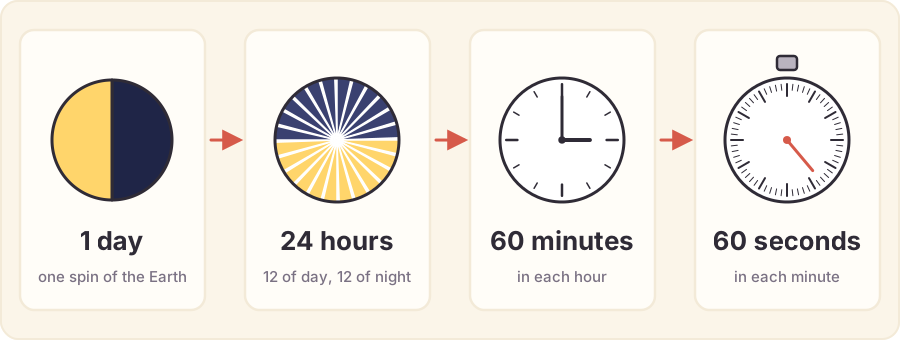
The symbols are h for hour, min for minute and s for second. A second is about how long it takes to say "one thousand and one" at a normal pace.
The second today
Notice that these units don't go in tens, like metric units do. We will see why in the next lesson.
Of all of them, scientists chose the second as the main unit of time. The Earth's spin is not perfectly steady - it changes by tiny amounts from year to year - so since 1967 the second has not been taken from the day at all. It is counted by atomic clocks, which count something that happens inside atoms billions of times a second and never changes. The best atomic clocks would lose less than a second in millions of years.
Try it at home
- Use a phone timer. Close your eyes, start it, and stop it when you think 60 seconds have passed. How close were you?
- Now try again counting "one thousand and one, one thousand and two..." Was that closer?
Words to know
- time - how long something lasts
- hour (h), minute (min), second (s) - parts of a day: 24 hours in a day, 60 minutes in an hour, 60 seconds in a minute
- atomic clock - a clock that counts seconds using atoms, the most exact clock there is
Big idea
The day, month and year come from the sky. The day was split into 24 hours, each hour into 60 minutes and each minute into 60 seconds. Today the second is counted by atomic clocks.