Your Foot, My Foot
Try this: walk across a room heel to toe, one foot right in front of the other, and count your feet. Now ask an adult to do the same. You will get two different numbers for the same room. Which one is right?
Measuring with your body
In the Why We Measure lesson we saw that measuring means comparing a thing with something both people know. The first things people compared with were their own bodies, because a body is always with you:
- a foot - the length of a foot, heel to toe;
- a hand span - from the tip of the thumb to the tip of the little finger, with the hand stretched wide;
- a cubit - from the elbow to the tip of the middle finger;
- a pace - one step.
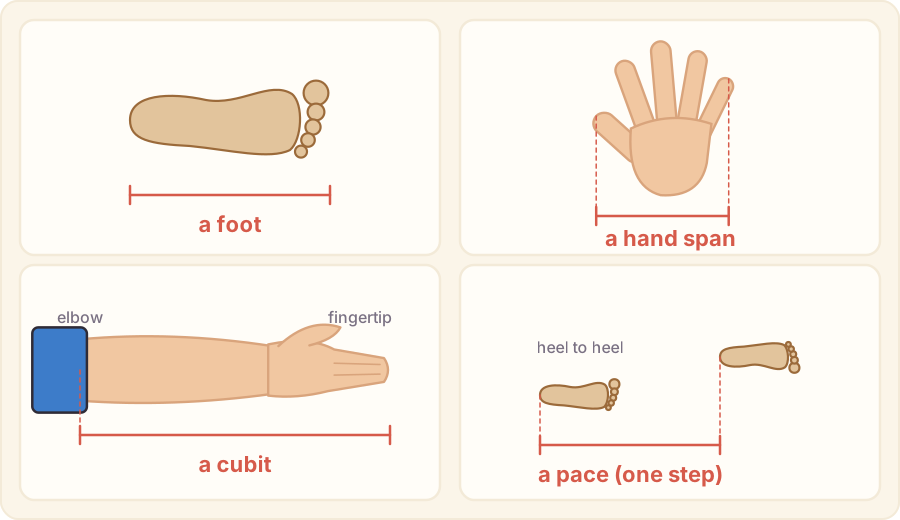
Some of these are still used today. People who keep horses still give a horse's height in "hands".
The trouble with bodies
Everybody's body is different. A child's foot is smaller than an adult's, so the same room is more of the child's feet and fewer of the adult's.
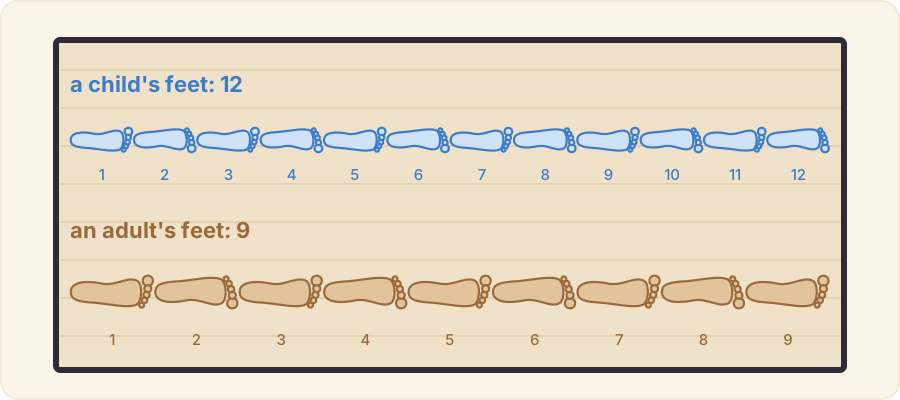
Both counts are honest, but they don't agree. Now imagine buying cloth "by the cubit". A seller with short arms gives you less cloth for the same money than a seller with long arms. For hundreds of years, towns and countries each had their own "foot", all a little different, and traders from different places argued about whose was right.

Picture: an illustration of buying cloth in a medieval market.
Everyone uses the same one
The fix was to stop using each person's own body and agree on one length that everybody uses. In ancient Egypt, builders used the royal cubit: one official length, copied onto rods of wood and stone, so every builder on the same job measured with exactly the same cubit.
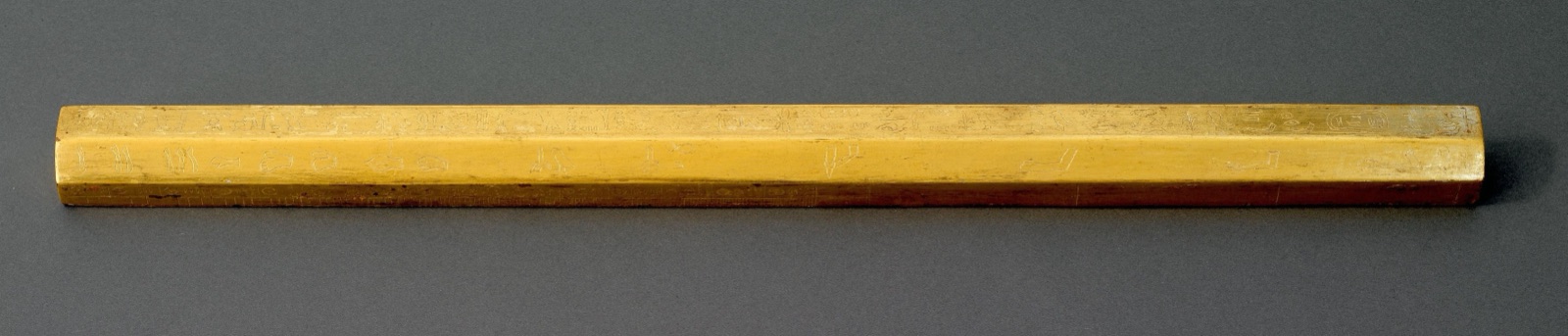
Picture: a royal cubit rod in the Museo Egizio, Turin (photo: Museo Egizio, CC0).
An amount that everyone agrees to measure with is called a unit. The official copy that everyone checks their own against is called a standard. Once there is a standard, your 10 cubits and my 10 cubits are the same length.
Try it at home
- Measure a table in your hand spans and write down the number.
- Ask someone with bigger (or smaller) hands to do the same.
- Now cut a piece of string as long as your span, and both of you measure the table with the string. Do you agree now? The string is your standard.
Words to know
- cubit - an old unit: the length from the elbow to the tip of the middle finger
- unit - an amount everyone agrees to measure with
- standard - the official copy of a unit that everyone checks against
Big idea
People first measured with their feet, hands and arms, but bodies differ, so their numbers didn't agree. Agreeing on one unit, with a standard to check against, makes everyone's measurements match.