Fahrenheit
A friend in the United States says: "It's going to be 100 degrees tomorrow!" In the Hot and Cold lesson we saw that water boils at 100 °C. Is your friend's city about to boil? No. They are using a different scale.
Another scale
In 1724 - eighteen years before Celsius - a thermometer maker named Daniel Gabriel Fahrenheit made his own scale. Fahrenheit made some of the best thermometers of his time, and his scale spread with them.
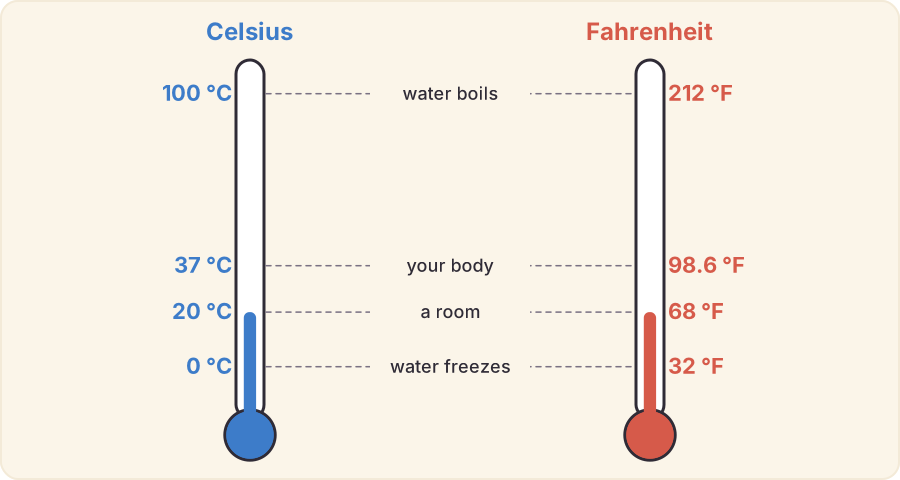
He picked different marks from the ones Celsius would later pick. His 0 was the coldest mixture he could make in his workshop: ice, water and a kind of salt. On his scale:
- water freezes at 32 degrees Fahrenheit, written 32 °F;
- water boils at 212 °F;
- a healthy body is about 98.6 °F;
- a very hot summer day is about 100 °F.
So your friend means a very hot day, but nothing like boiling.
Where it is used
Most of the world uses Celsius. The United States uses Fahrenheit for the weather, cooking and fevers. A few other places use it too.
Neither scale is "wrong". They measure the same temperature with different marks and different-sized degrees, the way a foot and a metre measure the same length. Between freezing and boiling, Celsius has 100 degrees and Fahrenheit has 180, so one Fahrenheit degree is smaller than one Celsius degree.
A rough rule
To change Celsius into Fahrenheit in your head: double it and add 30.
- 20 °C: double is 40, add 30: about 70 °F (exactly 68).
- 30 °C: 60 + 30: about 90 °F (exactly 86).
To go back from Fahrenheit to Celsius: take away 30, then halve it.
- 100 °F: take away 30 is 70, half is about 35 °C (exactly 37.8).
It is only rough, and it gets worse for very hot or very cold temperatures, but it is good enough to know whether to wear a coat.
Try it at home
- Find a weather website or app, and switch it between °C and °F.
- Use the rule on today's temperature, and check how close you got.
Words to know
- Fahrenheit scale (°F) - the scale where water freezes at 32 and boils at 212
Big idea
The Fahrenheit scale, used in the United States, puts freezing at 32 °F and boiling at 212 °F. To change Celsius to Fahrenheit roughly, double and add 30.