The Kilogram and the Gram
A bag of sugar says "1 kg". A bar of chocolate says "100 g". In the What Is Mass? lesson we saw that mass is how much stuff a thing is made of. These labels tell you the mass in units. But who decided how much a kilogram is?
Grams and kilograms
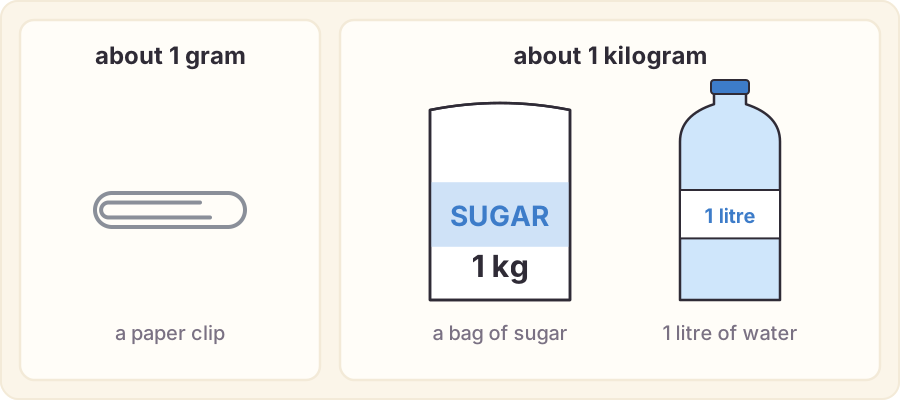
The metric unit for small masses is the gram, symbol g. A gram is very little: a paper clip is about a gram.
In the Kilo, Centi, Milli lesson we saw that kilo means a thousand. So a kilogram, symbol kg, is 1,000 grams. A bag of sugar, a big bottle of water or a small pineapple is about 1 kg.
For very small masses there is the milligram (mg), a thousandth of a gram - you may see it on a medicine box.
A cylinder in a safe
When the metric system was made in France in the 1790s, the kilogram was taken from water: one kilogram was meant to be the mass of a litre of water. (We will meet the litre in the last lesson of this module.)
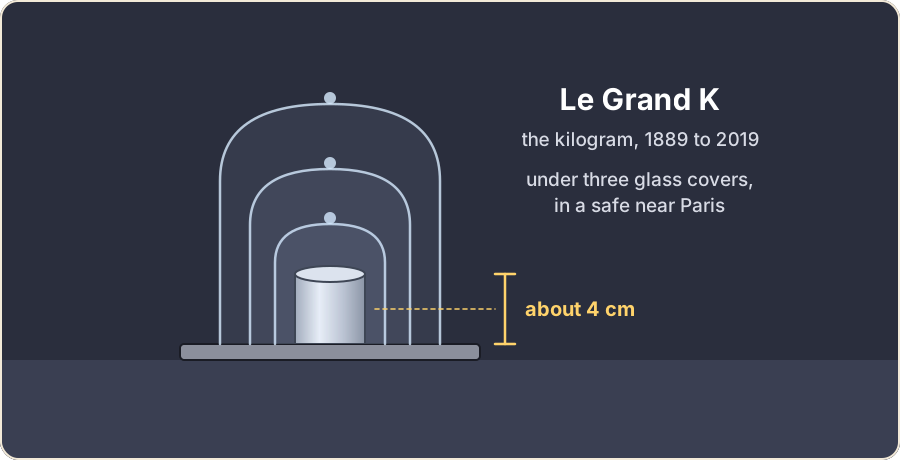
But water is hard to measure exactly. So in 1889 scientists made one special object and agreed that its mass is one kilogram. It is a small metal cylinder, about 4 centimetres tall and 4 centimetres wide - you could close your hand around it. It is kept in a safe near Paris, under three glass covers, and was called the International Prototype of the Kilogram, or "Le Grand K".
Copies were made and sent to countries all over the world. Every few decades the copies were brought back and compared with Le Grand K.
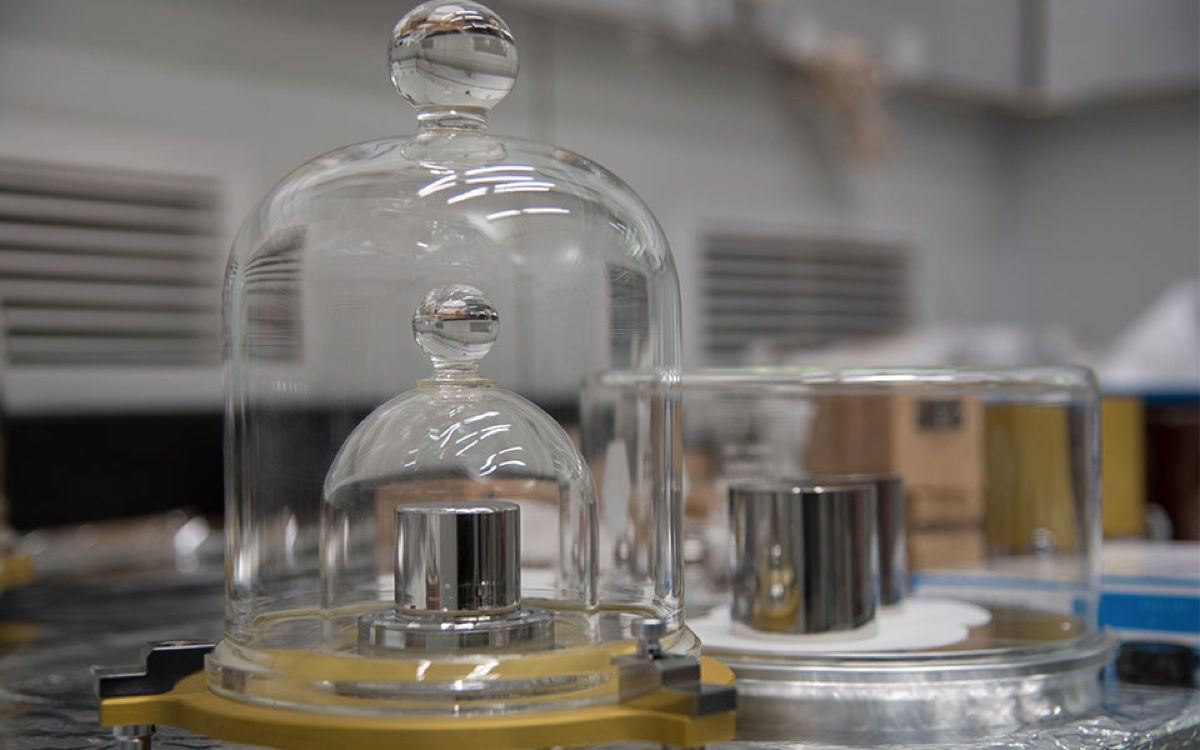
Picture: kilogram copies at NIST (NIST, public domain).
Why it was replaced
Over the years, the copies and Le Grand K slowly drifted apart, by tiny amounts: less than the mass of a grain of sand. Nobody knew which one had changed. And if Le Grand K was damaged, the kilogram itself would change.
So in 2019 the kilogram stopped being the mass of an object. It is now fixed using a number from nature that never changes, so anyone in the world with the right equipment can check it. Le Grand K is still in its safe, but it is no longer the standard.
Pounds
In the United States, and for some things in the United Kingdom, mass is given in pounds (lb). A pound is about 0.45 kg - a bit less than half a kilogram. So a 2-pound bag of sugar is a bit less than 1 kg.
Try it at home
- Read the labels on five packets in your kitchen. Which are in grams and which in kilograms?
- Hold a 1 kg bag of sugar or flour in one hand and a 100 g bar of chocolate in the other. The bag is ten times as much mass.
Words to know
- gram (g) - a small metric unit of mass, about a paper clip
- kilogram (kg) - 1,000 grams
- pound (lb) - an older unit of mass, about 0.45 kg
Big idea
Mass is measured in grams and kilograms; a kilogram is 1,000 grams. From 1889 to 2019 a kilogram was the mass of one metal cylinder in a safe near Paris. Now it is fixed by nature itself.