Smaller Than a Metre
How long is your thumbnail? How thick is a coin? "A tiny bit of a metre" is not a useful answer. For small things, we need smaller units.
Centimetres
In the Metre lesson we saw that a metre is about the length of a guitar. Split one metre into 100 equal parts, and each part is a centimetre. Its symbol is cm.
So 1 metre = 100 centimetres.
A centimetre is about the width of your little fingernail. The big numbered marks on most school rulers are centimetres. A pencil might be about 15 cm long, and a sheet of paper for a printer is about 30 cm long.
Millimetres
For even smaller things, split one centimetre into 10 equal parts. Each part is a millimetre. Its symbol is mm.
So 1 centimetre = 10 millimetres, and since a metre has 100 centimetres, 1 metre = 1,000 millimetres.
A bank card is a little less than a millimetre thick. The tiny marks between the numbers on a ruler are millimetres.
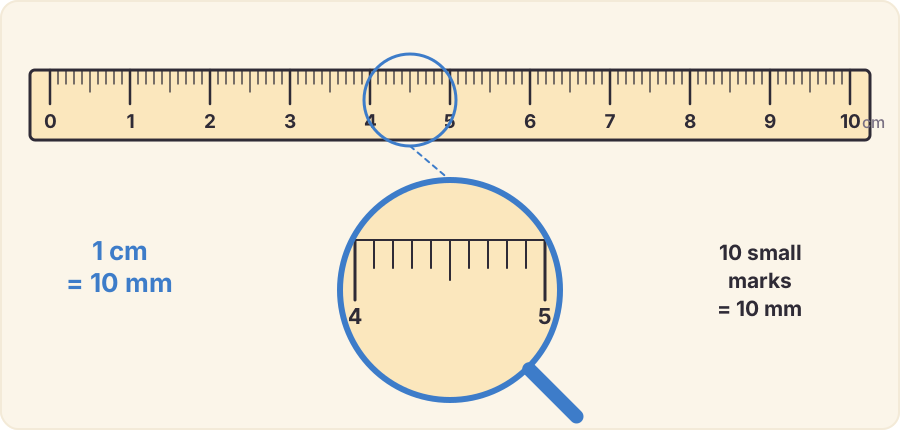
Reading a ruler
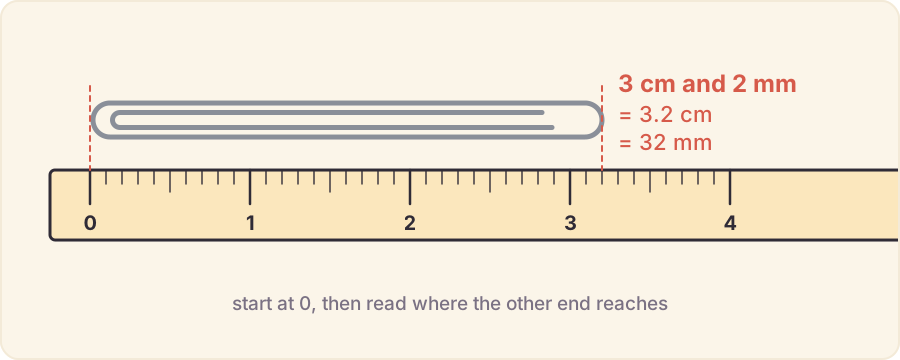
To measure something with a ruler:
- Put the end of the thing exactly at the 0 mark (not at the end of the ruler - on many rulers they are not the same).
- Look at where the other end of the thing reaches.
- Read the last centimetre number it passed, then count the small millimetre marks after it.
A paper clip that reaches 3 centimetre marks and 2 more small marks is 3 cm and 2 mm long. We can also write that as 3.2 cm, or as 32 mm - all three say the same length.
Try it at home
- Measure your thumbnail, a coin and a pencil with a ruler, starting at the 0 mark each time.
- Write each one in centimetres and millimetres, like "3 cm and 2 mm".
- Which of the three would you rather measure in millimetres only? Why?
Words to know
- centimetre - one hundredth of a metre; its symbol is cm. 100 cm = 1 m
- millimetre - one tenth of a centimetre, one thousandth of a metre; its symbol is mm. 10 mm = 1 cm
Big idea
For small things, a metre is split into 100 centimetres, and each centimetre into 10 millimetres. The big marks on a ruler are centimetres; the tiny ones are millimetres.