Why 60?
Metres go in tens: 10 millimetres, 100 centimetres, 1,000 metres. But time goes 60 seconds to a minute and 60 minutes to an hour. If metric units are so much easier, why didn't anyone make time go in tens?
Counting in sixties
About 4,000 years ago, in Mesopotamia (today's Iraq), the Sumerians and later the Babylonians counted in sixties, where we count in tens. Their astronomers used it to record the sky, and astronomers in other lands copied it for thousands of years. When hours were later split into smaller parts, it was these astronomers who did it - in sixties. That is why there are 60 minutes in an hour and 60 seconds in a minute.
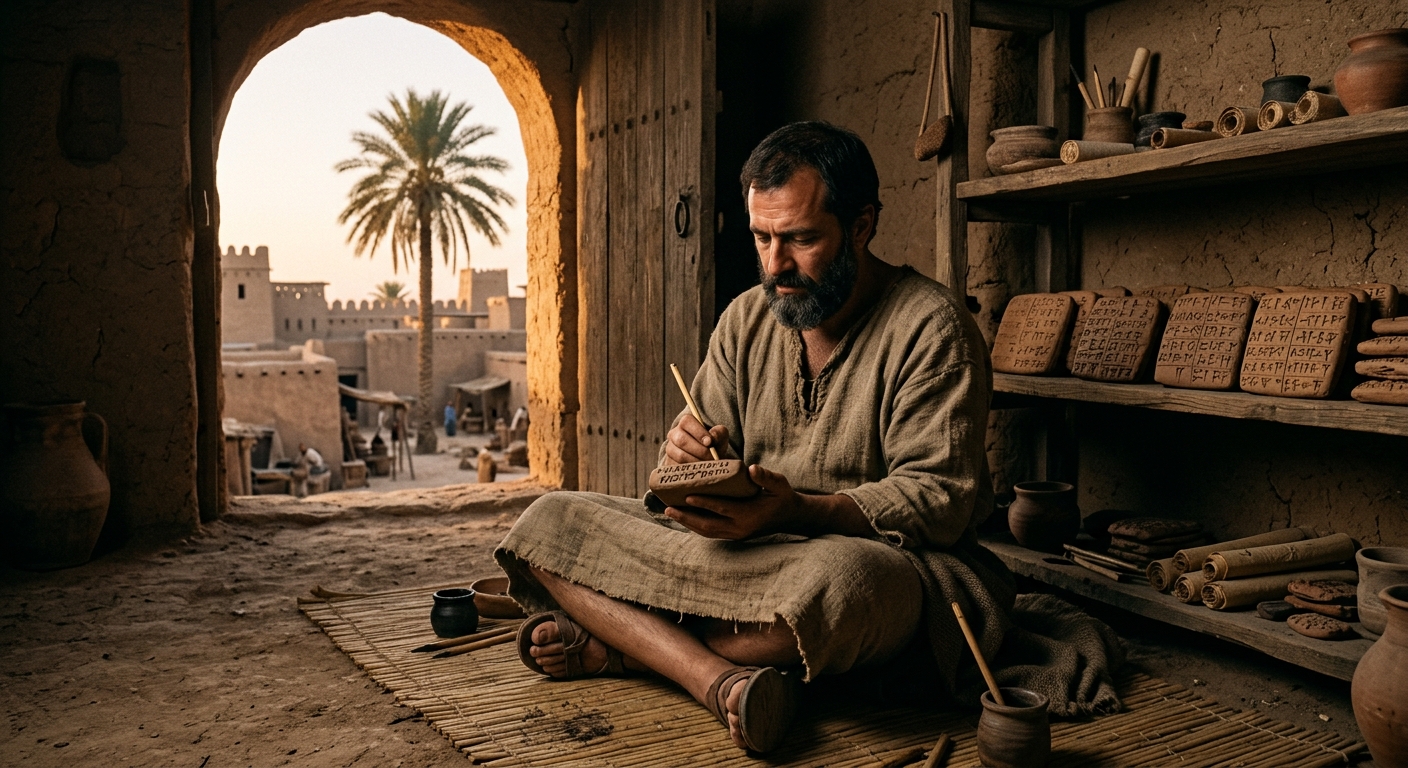
Picture: an illustration of a scribe in ancient Babylon writing on clay, about 4,000 years ago.
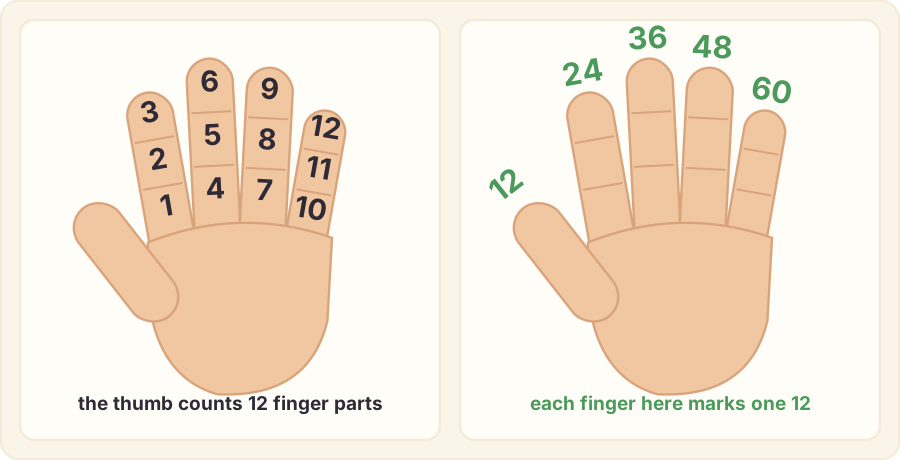
One idea for why people counted in sixties uses your hands. Use your thumb to touch the three parts of each of your other four fingers: that is 12 parts. Each time you get to 12, fold down one finger of your other hand. Five fingers of 12 make 60.
60 splits evenly
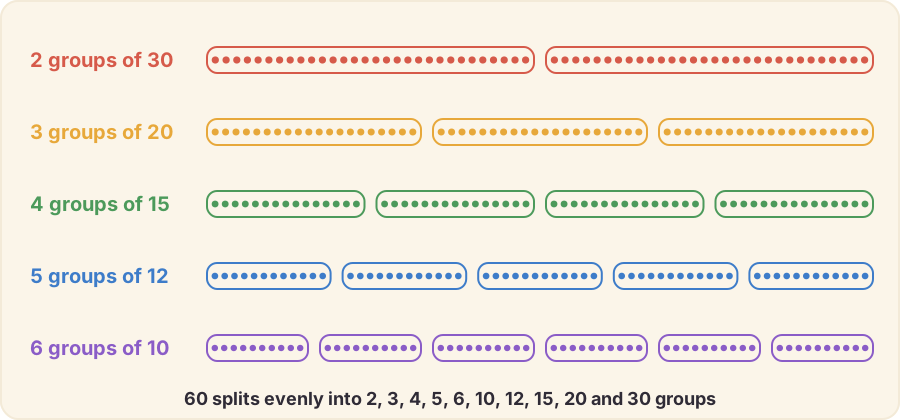
There is a better reason the sixties lasted. 60 can be split into equal parts in many ways: into 2, 3, 4, 5, 6, 10, 12, 15, 20 or 30 equal groups. 10 can only be split into 2 or 5.
So an hour splits neatly into halves (30 minutes), thirds (20 minutes), quarters (15 minutes), fifths, sixths and more. A "quarter past" is a whole number of minutes. With a 100-minute hour, a third of an hour would be 33 and a third minutes.
The ten-hour day
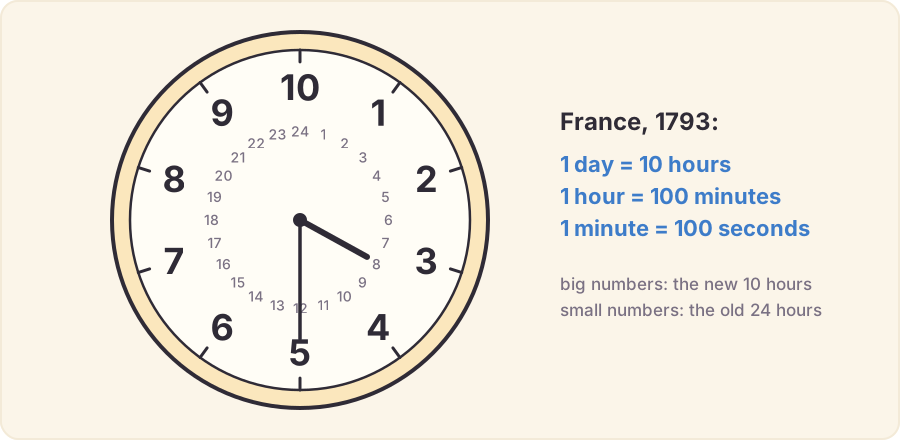
The French did try. In the Metre lesson we saw that after the revolution of 1789, France made new units that went in tens. In 1793 they did it for time too: a day of 10 hours, each hour of 100 minutes, each minute of 100 seconds. Clocks were made with 10 hours on the face.
Nobody liked it. Every clock and watch in the country would have had to be replaced, and people were used to the old hours. The ten-hour day was used for less than two years. The metre stayed; the 60-minute hour did too.
Try it at home
- Try the counting trick: count to 60 on your fingers using your thumb and the finger parts.
- How many minutes is a third of an hour? A fifth? A sixth? (Answers: 20, 12 and 10.)
Words to know
- Babylon - a great city of ancient Mesopotamia (today's Iraq), whose people counted in sixties
Big idea
Minutes and seconds go in sixties because people in ancient Mesopotamia counted in sixties, and astronomers kept the habit. It lasted because 60 splits evenly in many ways. France tried a ten-hour day, but it didn't last.