Kilo, Centi, Milli
You have met the kilometre, the centimetre and the millimetre. Look at a bag of rice and you may see "kg", short for kilogram. Look at a bottle of water and you may see "ml", short for millilitre. We will meet grams and litres later in the course. But you can already guess a lot about them. How?
Three words with one meaning each
Look again at the lengths from the last module:
- a kilometre is 1,000 metres;
- a centimetre is a hundredth of a metre (100 of them make a metre);
- a millimetre is a thousandth of a metre (1,000 of them make a metre).
The front part of each word tells you how big it is compared with a plain metre. A front part like this is called a prefix:
- kilo means a thousand (from Greek);
- centi means a hundredth (from Latin, where centum is a hundred);
- milli means a thousandth (from Latin, where mille is a thousand).
The same prefixes on every unit
Here is the trick. The prefixes mean the same thing whatever unit they are put in front of. So without knowing anything else:
- a kilogram must be 1,000 grams;
- a millilitre must be a thousandth of a litre, so 1,000 millilitres make a litre;
- a centilitre must be a hundredth of a litre.
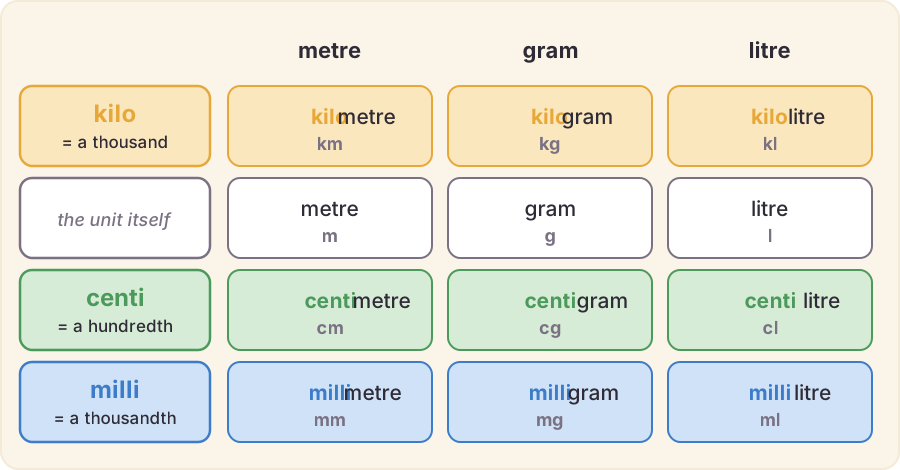
The symbols follow the same pattern too: k for kilo, c for centi and m for milli, put in front of the unit's own symbol. So km, cm and mm for lengths, and kg and ml on the rice and the water.
Why this makes life easy
In the Inches, Feet and Miles lesson we saw that the older units each need their own number: 12 inches in a foot, 3 feet in a yard, 1,760 yards in a mile. You have to learn a new number for every step, and the numbers change from one kind of unit to another.
With metric units there are only a few prefixes to learn, they all go in tens, hundreds and thousands, and they work on every unit. Learn them once, and you know them everywhere.
There are more prefixes for very big and very small things - you may have seen "mega" on a phone's storage. They belong to a later course.
Try it at home
- Search your kitchen for labels with k, c or m in front of a unit: kg, g, ml, cl, l.
- For each one, say what the prefix means. A 500 ml bottle holds 500 thousandths of a litre: that is half a litre.
Words to know
- prefix - a small word part put at the front, like kilo, centi or milli
- kilo (k) - a thousand
- centi (c) - a hundredth
- milli (m) - a thousandth
Big idea
Kilo means a thousand, centi a hundredth and milli a thousandth, and each means the same on every metric unit. Learn the prefixes once and you can work out units you have never met.