One System for the Whole World
A scientist in Japan measures something in metres. An engineer in Brazil reads the result, and a factory in Germany builds a part to fit. None of them has met. How can they be sure they all mean exactly the same metre?
The countries agree
In the Metre lesson we saw that France made the metre in the 1790s. Over the next 80 years, more and more countries started to use it. But each kept its own copy of the standard, and the copies could drift apart.
So in 1875, in Paris, 17 countries signed an agreement, the Metre Convention. They set up an international office near Paris to keep the standards and compare every country's copies with them. In the Kilogram lesson we met one of the standards it kept: Le Grand K.
In 1960 the system of units they shared got a name: the International System of Units, or SI for short (from its French name, Système international). Today nearly every country uses it. Even the inch and the pound used in the United States are defined using SI units.
The base units
The SI is built on seven base units. You have met four of them in this course:
- the metre (m), for length;
- the kilogram (kg), for mass;
- the second (s), for time;
- the kelvin (K), for temperature.
The other three - the ampere (for electric current), the mole (for counting tiny things like atoms) and the candela (for how bright a light is)
- belong to later courses.
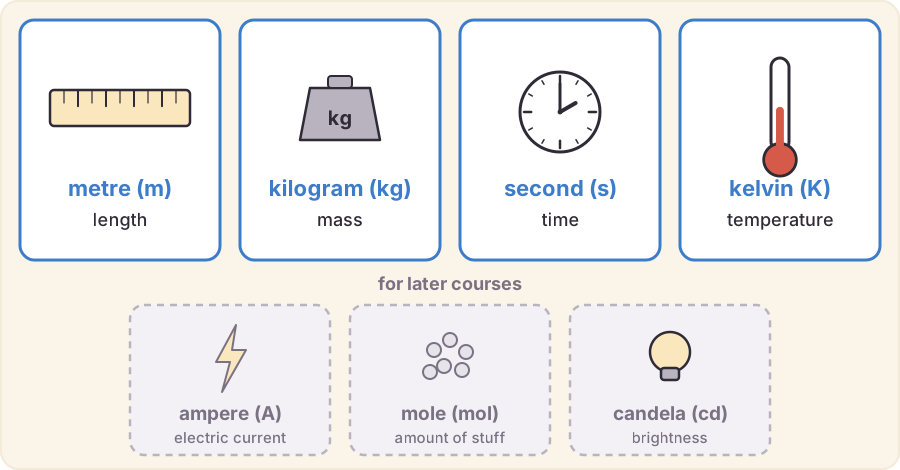
With the prefixes from the Kilo, Centi, Milli lesson, the base units make all the others: kilometres, milligrams, milliseconds.
The kelvin
The kelvin may be new. In the Hot and Cold lesson we saw that the Celsius scale starts at freezing water. But things can get much colder than that, and there is a coldest temperature possible, colder than anything can ever be: about 273 degrees below zero on the Celsius scale. The kelvin scale starts there, at 0 K, and goes up in steps the same size as Celsius degrees. So water freezes at about 273 K.
Fixed by nature
In the Metre and Kilogram lessons we saw that both units were once kept as metal objects in Paris, and that objects can change. Since 2019, all seven base units are fixed using numbers from nature - like the speed of light - that are the same everywhere and never change. Any good laboratory in the world can now check the metre for itself.
Try it at home
- Look at three labels or packets at home. Which SI units, or units made from them with prefixes, can you find?
- Is there anything at home measured in units that are not SI? (Hint: look at screens and tyres.)
Words to know
- SI - the International System of Units, shared by nearly every country
- base unit - one of the seven units the SI is built on
- kelvin (K) - the SI unit of temperature; 0 K is the coldest possible temperature
Big idea
The SI is one system of units that nearly the whole world shares, built on seven base units, including the metre, the kilogram, the second and the kelvin. Since 2019 all of them are fixed by nature itself.