What Is Mass?
Imagine two boxes, exactly the same size. One is full of feathers, the other is full of sand. Pick them up, one in each hand. One is easy to lift; the other pulls your arm down. They take up the same space, so what is different?
How much stuff
Everything is made of stuff: wood, water, metal, air, the cells of your own body. Some things pack a lot of stuff into a small space, like a stone. Others spread a little stuff over a big space, like a pillow.
How much stuff a thing is made of is called its mass. The box of sand has much more mass than the box of feathers, even though the two boxes are the same size.
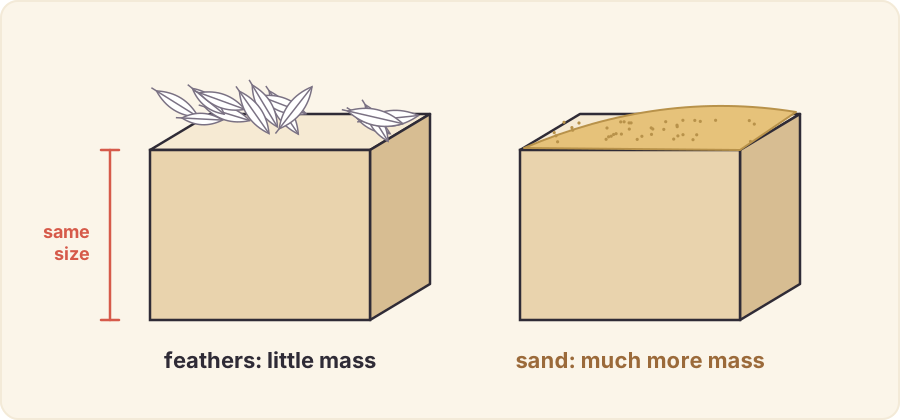
So size doesn't tell you mass. A small stone can have more mass than a big pillow. To find mass, you have to measure it.
The balance
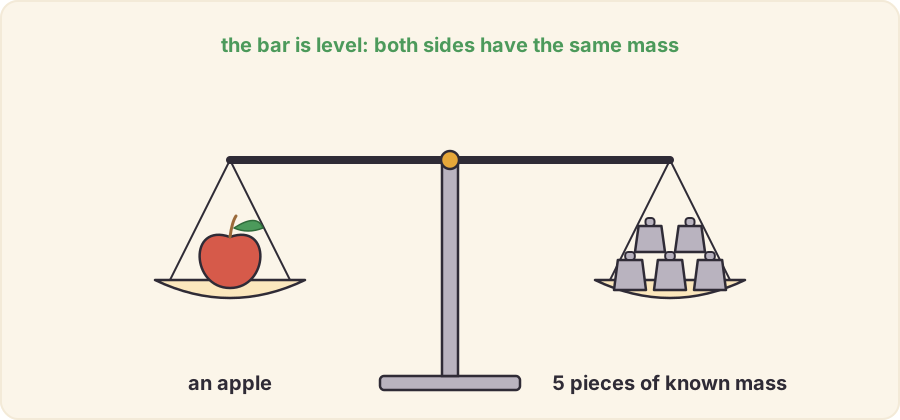
The oldest tool for measuring mass is the balance: a bar resting on a point in the middle, with a pan hanging from each end. Put a thing in one pan. If one side goes down, that side has more mass. If the bar stays level, the two sides have the same mass.
People have used balances for more than 4,000 years. A trader put the goods in one pan and pieces of metal or stone of known mass in the other, adding pieces until the bar was level. Then they counted the pieces. Do you see what that is? In the Why We Measure lesson we saw that measuring means comparing a thing with something both people know. The known pieces are the units.
Today's scales
Most scales today don't have two pans. A kitchen scale or a bathroom scale has a spring or an electronic part inside that is pressed down by what you put on it, and it shows a number. But the idea is the same: the number tells you how much mass is on the scale, in units. In the next lesson we will meet those units.
Try it at home
- Make a balance: hang a coat hanger from a door handle, and hang a plastic bag from each end.
- Put an apple in one bag. Add coins to the other bag until the hanger is level.
- Now try a pencil, a spoon or a small toy. How many coins is each one? You just measured mass in "coins".
Words to know
- mass - how much stuff a thing is made of
- balance - a tool that compares two masses: a bar with a pan at each end
Big idea
Mass is how much stuff a thing is made of. Size doesn't tell you mass: you have to measure it, and the oldest way is a balance, comparing the thing with pieces of known mass.