Where Does the Sugar Go?
Kofi stirs a spoonful of sugar into a glass of water. For a moment he can see the white grains swirling around. Then they are gone, and the water looks as clear as before. But when he takes a sip, it tastes sweet. So where did the sugar go?
The sugar is still there
The sweet taste tells Kofi the sugar has not vanished. There is a second way to check. Put the glass of water and the spoonful of sugar together on a kitchen scale, and write down the number. Then stir the sugar in until it is gone, and weigh again. The scale shows the same number. The sugar is still in the glass. You just can't see it any more.
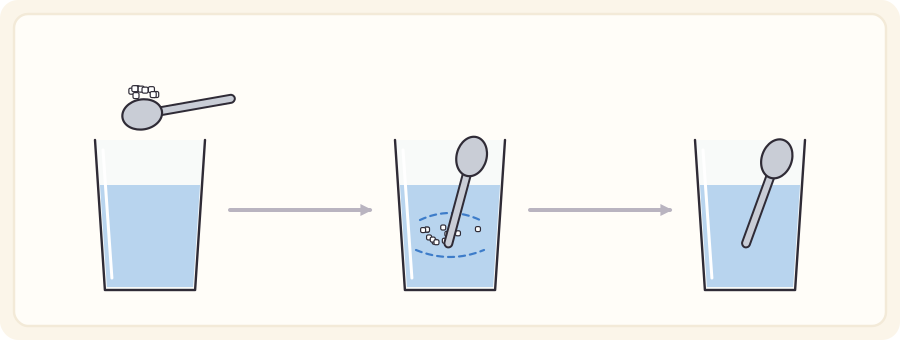
When something mixes into a liquid like this and seems to disappear, we say it dissolves. The sugar dissolved in the water. The mixture you get, sweet and see-through, is called a solution. In the Pure or Mixed? lesson we met mixtures. A solution is a special kind of mixture: one where the parts are mixed so finely that it looks like one thing.
What the particles are doing
In the Tiny Moving Particles lesson we saw that everything is made of tiny particles that are always moving. A grain of sugar is a huge crowd of sugar particles stuck together. When the grain is in water, the moving water particles bump into it and pull sugar particles away from the grain, one by one. The sugar particles spread out between the water particles, all through the glass.
Each sugar particle is far too small to see. That is why the water looks clear, and why it tastes sweet everywhere, at the top and at the bottom.
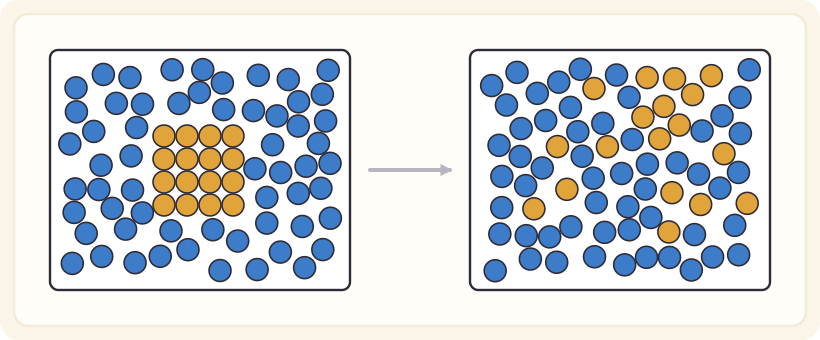
Warm water dissolves sugar faster than cold water, because its particles move faster and bump harder. Stirring helps too. But a glass of water can only dissolve so much: keep adding sugar, and at some point the extra sugar just sits at the bottom.
Not everything dissolves
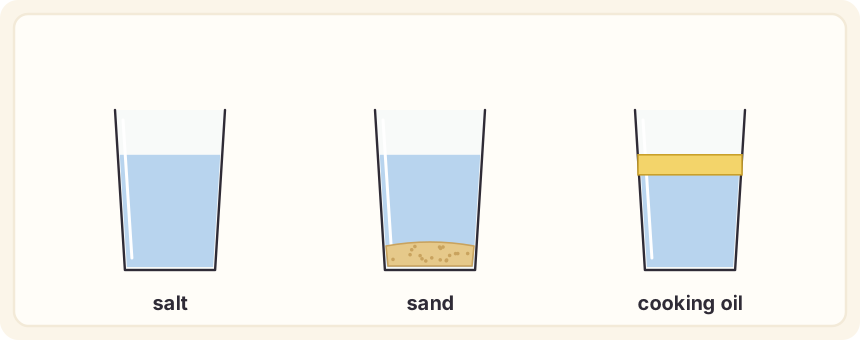
Salt dissolves in water, like sugar. We say salt and sugar are soluble in water. But sand does not. Stir sand into water and it swirls around, then sinks to the bottom, still sand. Pepper floats or sinks, and cooking oil floats on top in a layer. These are insoluble in water: they don't dissolve.
Try it at home
- Fill four glasses with the same amount of warm tap water.
- Add one teaspoon of something different to each: sugar, salt, sand (or soil) and flour.
- Stir each one for a minute, then wait a minute and look.
You should see that the sugar and the salt disappear and the water stays clear: they are soluble. The sand sinks and the flour makes the water cloudy and slowly settles: they don't dissolve.
Careful
Don't drink from the glasses, and only ever taste things that are food.
Words to know
- dissolve - to mix into a liquid so finely that you can't see it any more, like sugar in water
- solution - the clear mixture you get when something dissolves in a liquid
- soluble - able to dissolve in a liquid, like salt and sugar in water
- insoluble - not able to dissolve in a liquid, like sand in water
Big idea
When sugar dissolves in water it doesn't disappear. Its particles spread out between the water particles, too small to see. Some substances dissolve in water and some don't.