Reading a Formula
A recipe card for pancakes might say: 2 eggs, 1 cup of flour, 1 cup of milk. It tells you what goes in and how much of each. Chemists have a recipe card for substances too, and you have almost certainly seen one: H₂O, the formula for water. How do you read it?
Letters and small numbers
A chemical formula is a short way of writing which atoms are in a substance and how many of each. It is built from two things:
- Chemical symbols, which we met in Chemical Symbols: H for hydrogen, O for oxygen, C for carbon, and so on. Each symbol stands for one element.
- Small numbers, written a little lower than the letters. A small number says how many atoms there are of the element just before it. No number means one.
So H₂O means: H with a small 2, so two hydrogen atoms, then O with no number, so one oxygen atom. That is exactly the water molecule from When Atoms Join Up.
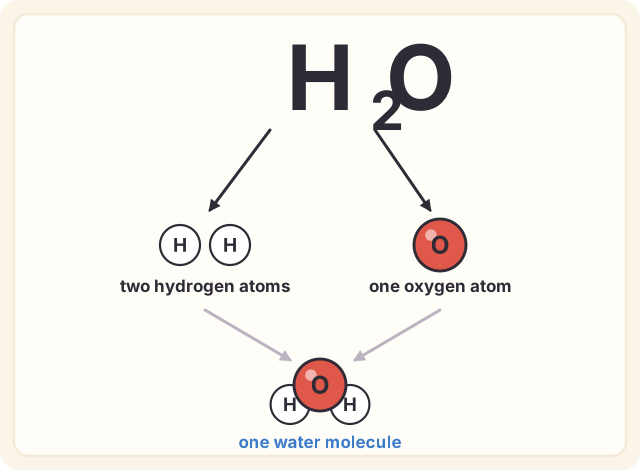
The small number belongs only to the symbol right before it. In H₂O, the 2 is about the hydrogen, not the oxygen.
Reading some more
Let's read a few formulas, one symbol at a time.
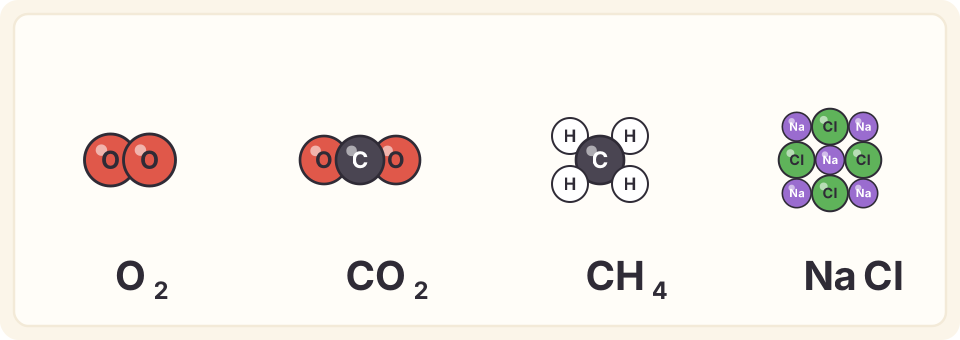
- O₂ - two oxygen atoms. This is the oxygen molecule in the air. Only one element, so it is not a compound.
- CO₂ - one carbon atom and two oxygen atoms. This is carbon dioxide, the gas you breathe out.
- CH₄ - one carbon atom and four hydrogen atoms. This is methane, the natural gas that burns in many cooking stoves. One molecule has five atoms in all.
- NaCl - sodium and chlorine. This is table salt from Compounds: Something New. Salt has no small molecules, so here the formula tells you something slightly different: there is one sodium for every chlorine.
Some formulas are long. Table sugar is C₁₂H₂₂O₁₁: twelve carbon atoms, twenty-two hydrogen atoms and eleven oxygen atoms. That is 45 atoms in a single sugar molecule.
One atom makes a big difference
Look at these two formulas: CO₂ and CO. They differ by just one oxygen atom. CO₂, carbon dioxide, is the harmless gas in your breath and in the bubbles of fizzy drinks. CO, called carbon monoxide, is a poisonous gas that can come from a stove or heater that burns badly. That is why many homes have an alarm for it.
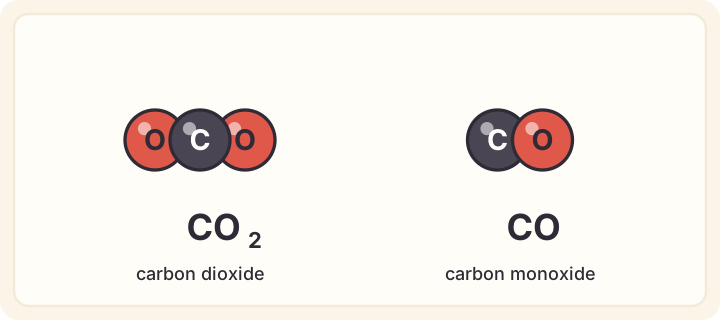
As we saw with compounds, the atoms you join, and how many of each, decide what the substance is like. A formula shows that recipe in a few letters.
Try it at home
- If you built fruit models in When Atoms Join Up, use them again. Otherwise take grapes for oxygen, blueberries for hydrogen, and a third kind of fruit (a raisin or a cherry tomato) for carbon.
- Build CO₂: one carbon in the middle and one oxygen on each side.
- Build CH₄: one carbon with four hydrogens around it. Count the atoms: five.
- Write the formula of each model on a piece of paper and put it next to the model.
Careful
Toothpicks are sharp. Keep them away from small children.
Words to know
- chemical formula - a short way of writing which atoms are in a substance and how many of each, like H₂O for water
Big idea
A chemical formula is a recipe. The symbols say which atoms, and the small number after a symbol says how many atoms of that element; no number means one.