Atoms Change Partners
Two lessons in this course seem to pull against each other. In Making New Stuff we saw that a chemical reaction makes new substances that weren't there before. In Nothing Disappears we saw that, in a sealed bag, the mass after a reaction is exactly the same as before. How can something new appear while nothing is added and nothing is lost? Now that we know about atoms, molecules and formulas, we can answer that.
A reaction is a swap
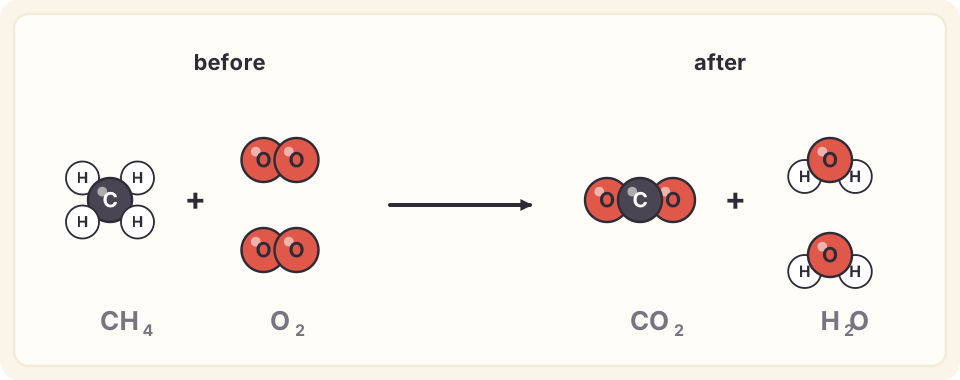
Here is the answer: in a chemical reaction, the atoms change partners. The molecules of the reactants (what you start with) come apart, and their atoms join up again in new groups. Those new groups are the products (what you end with).
No atom is made. No atom is destroyed. And no atom turns into a different kind of atom: a carbon atom stays a carbon atom, an oxygen atom stays an oxygen atom. Only the partners change.
Let's watch it happen in the blue flame of a gas cooker. The gas is methane, CH₄, which we met in Reading a Formula. When it burns, each methane molecule reacts with two oxygen molecules, O₂, from the air. The products are one carbon dioxide molecule, CO₂, and two water molecules, H₂O.
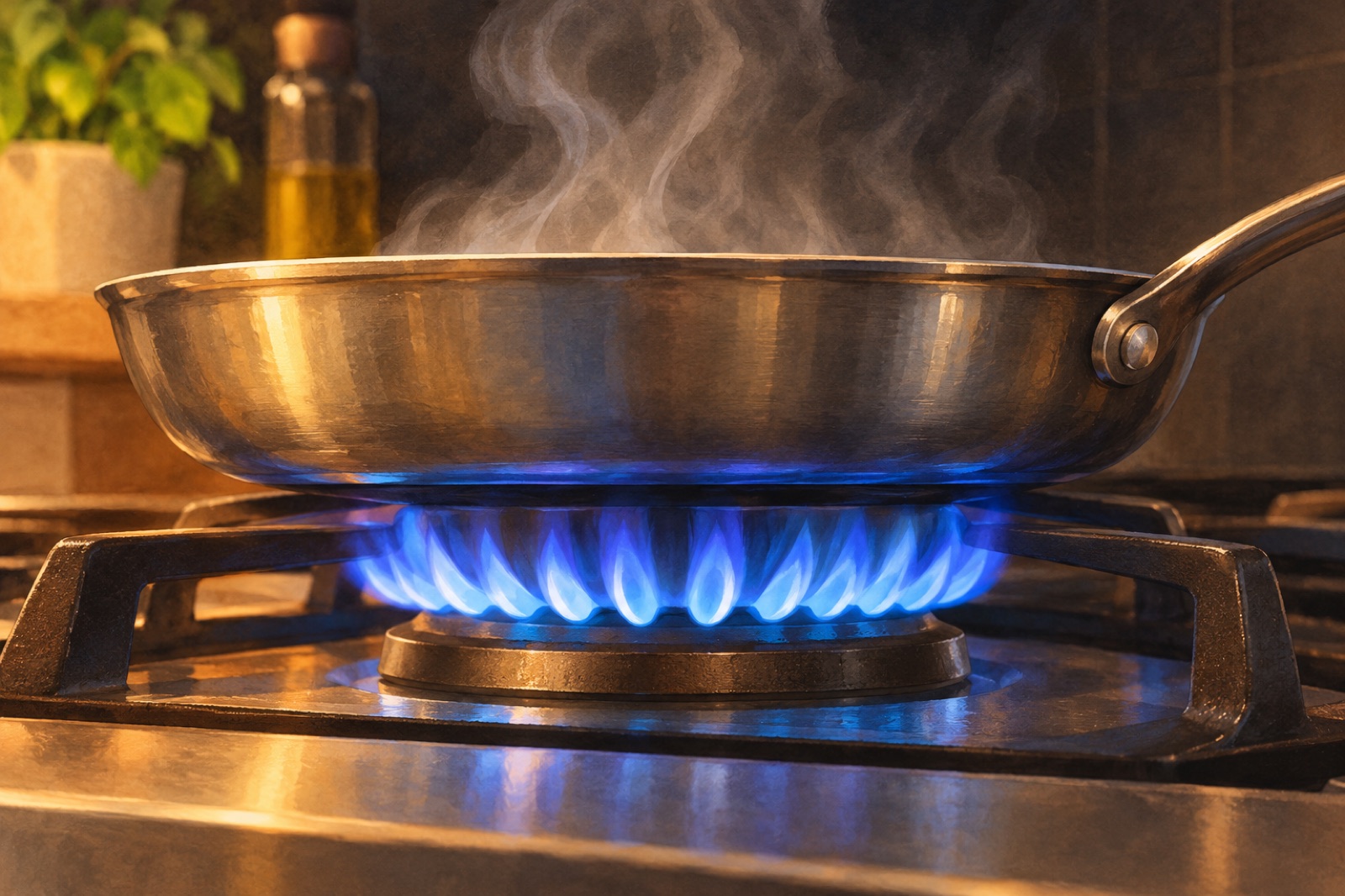
Picture: an illustration of the blue flame of a gas cooker, where methane reacts with oxygen from the air.
Count the atoms
Now count the atoms on each side, one element at a time.
- Carbon: before, one (in the methane). After, one (in the carbon dioxide).
- Hydrogen: before, four (in the methane). After, four (two in each water molecule).
- Oxygen: before, four (two in each oxygen molecule). After, four (two in the carbon dioxide, one in each water molecule).
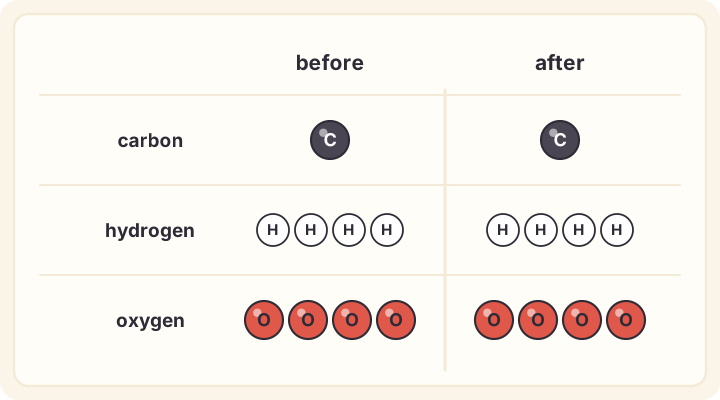
The same atoms are there at the end as at the start, just joined in new ways. Every atom has its own mass, so if all the same atoms are still there, the total mass must be the same too. That is the reason behind conservation of mass.
This also explains the burnt log from Nothing Disappears. The ash weighs much less than the log, but no atoms were lost. Most of the log's carbon and hydrogen atoms joined up with oxygen from the air and floated away as carbon dioxide and water vapour, gases you can't see.
The whole course in one sentence
Look back at where we started. Everything around you - water, salt, air, a candle, your own body - is made of atoms of about 90 elements, joined up in different ways. And every chemical change, from rust on a bicycle to a cake rising in the oven, is atoms letting go of old partners and taking new ones.
Try it at home
- With your fruit models from When Atoms Join Up, build one CH₄ and two O₂: one carbon fruit, four hydrogen fruits and four oxygen fruits.
- Take all the molecules apart.
- Use the same fruits to build one CO₂ and two H₂O.
- Check: is any fruit left over? Did you need any extra? If you counted right, the answer to both is no. That is conservation of mass.
Careful
Toothpicks are sharp. Keep them away from small children. Never play with a gas cooker: only an adult should light one.
Words to know
- chemical reaction - a change that makes new substances, by atoms changing partners
- conservation of mass - in a chemical reaction, the total mass stays the same, because the same atoms are there before and after
Big idea
In a chemical reaction, atoms are never made, destroyed or changed into other atoms. They only let go of their partners and join up in new ways, so the same atoms, and the same mass, are there before and after.