Solids, Liquids and Gases
Leo is packing a picnic. He puts a sandwich in a box, pours juice into a bottle and blows up a balloon for his little sister. A sandwich, juice, the air in a balloon: three very different kinds of stuff. Each one needs a different kind of container. Why?
Three ways to be stuff
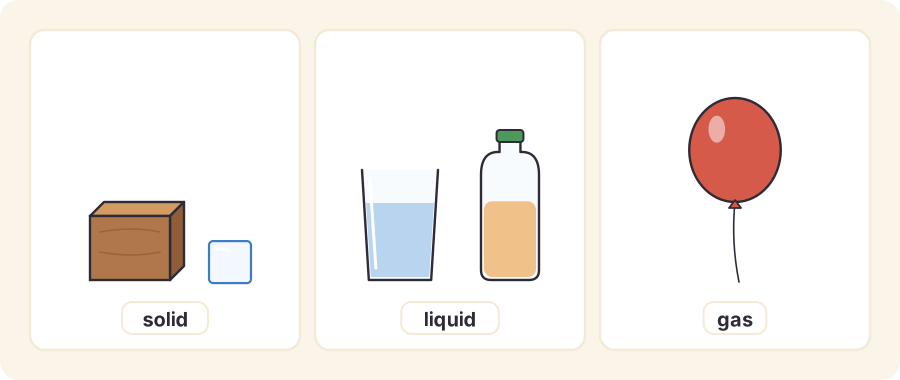
In What Is Matter? we saw that matter is anything that has mass and takes up space. Nearly all the matter around you comes in one of three forms:
- a solid, like a stone, a spoon, a sandwich or an ice cube;
- a liquid, like water, milk, juice or cooking oil;
- a gas, like the air around you or the air inside a balloon.
These three forms are called the states of matter. "State" here just means the form something is in, the way you might say a room is in a tidy state.
How can you tell them apart?
Try to put each one into a different container, and watch what it does.
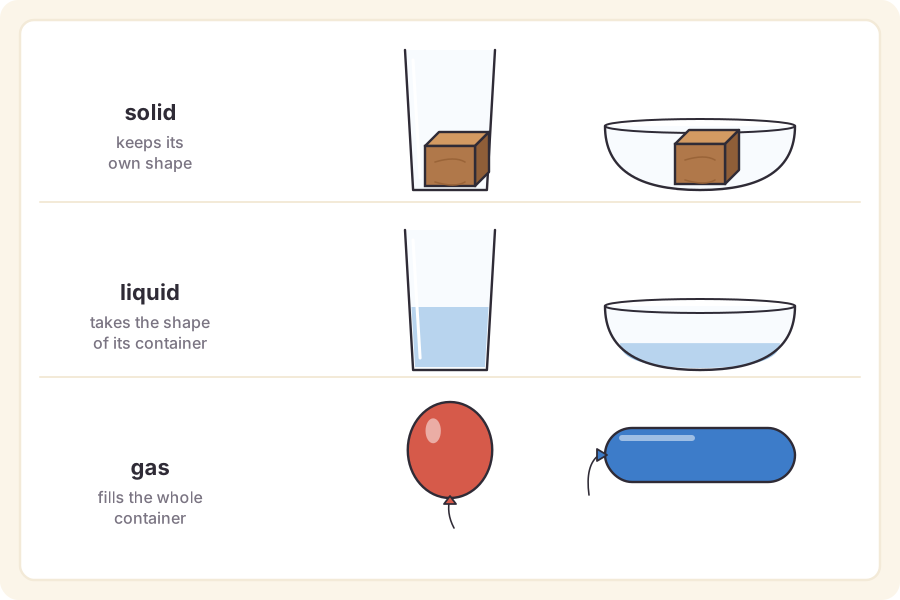
A solid keeps its own shape. Put a wooden block into a tall glass or a wide bowl, and it stays the same block. You can't pour it, and you can't squeeze it into a smaller space.
A liquid takes the shape of its container, but keeps its amount. Pour a glass of water into a wide bowl, and the water spreads out flat at the bottom. Pour it back, and you get the same glassful. A liquid flows, but one litre of water stays one litre of water.
A gas fills whatever container it is in. The air you blow into a balloon spreads out to fill the whole balloon, whatever its shape. A gas has no shape of its own and no fixed amount of space: you can squeeze it into a smaller space, and it spreads into a bigger one.
Tricky cases
Some things look like they break the rules. Sand can be poured, so is it a liquid? No. Look closely and each grain of sand is a tiny solid that keeps its own shape. A heap of sand only flows because the grains roll over each other. Sugar and salt are the same.
Honey and toothpaste are thick and slow, but they are still liquids: give them time and they take the shape of their container. And air is easy to forget, because you can't see it. But it is a gas, and it is real stuff: it fills balloons, tyres and your lungs.
Try it at home
- Find one solid, one liquid and something that holds a gas (a balloon or a plastic bottle with its lid on).
- Pour a glass of water into a wide bowl, then back into the glass. Does the amount change?
- Squeeze the closed bottle. Then try to squeeze a full bottle of water.
The bottle of air squeezes in easily, because a gas can be pushed into a smaller space. The bottle of water hardly squeezes at all: a liquid keeps its amount.
Words to know
- solid - stuff that keeps its own shape, like a stone or an ice cube
- liquid - stuff that flows and takes the shape of its container, but keeps its amount, like water
- gas - stuff that spreads out to fill any container, like air
- state - which of the three forms (solid, liquid or gas) something is in
Big idea
Nearly all matter is a solid, a liquid or a gas. A solid keeps its shape, a liquid takes the shape of its container but keeps its amount, and a gas spreads out to fill any space it is in.