Cut It in Half Again
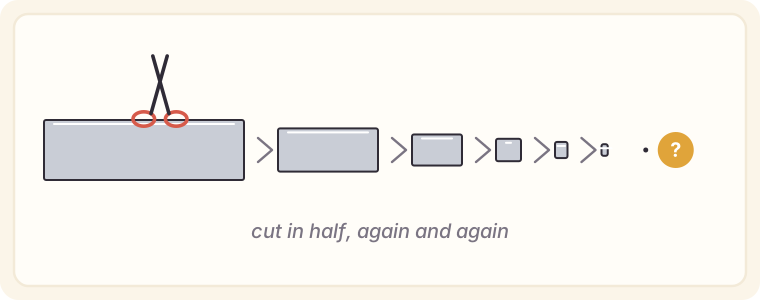
Take a strip of kitchen foil and cut it in half. Then cut one of the halves in half, and again, and again. After a few cuts the pieces are too small for your scissors. But imagine you had perfect scissors and perfect eyes. Could you go on cutting for ever, or would you reach a piece that cannot be cut any more?
An old question
People asked this question long before anyone could check the answer. About 400 BCE, in ancient Greece, a thinker called Democritus said that you could not cut for ever. In the end, he said, you would reach tiny pieces that cannot be cut. He called them atomos, which means "uncuttable" in Greek.
For more than two thousand years nobody could prove him right or wrong. Then, in 1808, an English teacher called John Dalton showed that the way substances combine makes sense only if they are made of tiny pieces, each with its own weight. Today we call these pieces atoms.
Everything is made of atoms
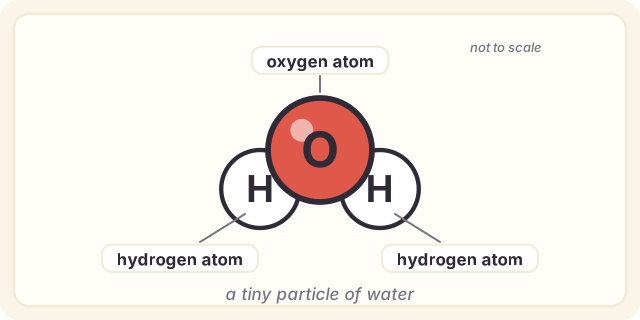
In Tiny Moving Particles we saw that all matter is made of tiny particles that are always moving. Now we can say what those particles are made of: atoms. Sometimes a particle is a single atom. More often it is a small group of atoms held tightly together. A tiny particle of water, for example, is a group of three atoms: one atom of a kind called oxygen and two atoms of a kind called hydrogen.
The air you breathe, the water you drink, your chair, your hair and your own body are all made of atoms. So the foil was made of atoms too. If you could keep cutting, you would end with a single atom of aluminium: the smallest piece that is still aluminium.
How small is an atom?
Atoms are far too small to see, even with the best magnifying glass. A human hair is about a million atoms wide. A single grain of salt holds more atoms than there are grains of sand on a beach.
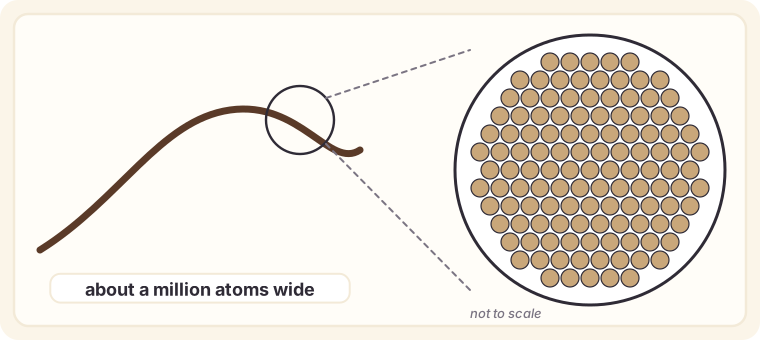
For a long time, nobody had seen a single atom. Since the 1980s, special microscopes can make pictures of atoms, and they show bumps neatly lined up, just as Democritus and Dalton imagined.
Try it at home
- Cut a strip of paper about as long as your hand.
- Cut it in half. Keep one half and cut that in half. Count your cuts.
- Stop when the piece is too small to hold or cut.
Most people manage seven or eight cuts. To get down to a single atom you would need only about twenty more cuts, but no scissors are that small.
Words to know
- atom - one of the tiny pieces that all matter is made of, far too small to see
Big idea
All matter is made of atoms, pieces far too small to see. Most tiny particles of a substance are small groups of atoms held together.