When Atoms Join Up
Look at a glass of water. In Cut It in Half Again we saw that everything is made of atoms. In Elements: One Kind of Atom we saw that an element is made of only one kind of atom. But water is not an element. You won't find water on the periodic table. So what is water made of, and how?
Atoms in small groups
The answer is that atoms can join up. Two or more atoms can hold on to each other and stay together, like children holding hands in a ring. A small group of atoms joined together is called a molecule.
Water is made of tiny molecules, all exactly alike. Each water molecule is two hydrogen atoms and one oxygen atom, joined together. The oxygen atom sits in the middle, and the two hydrogen atoms hold on to it, one on each side, a bit like the ears on a head.
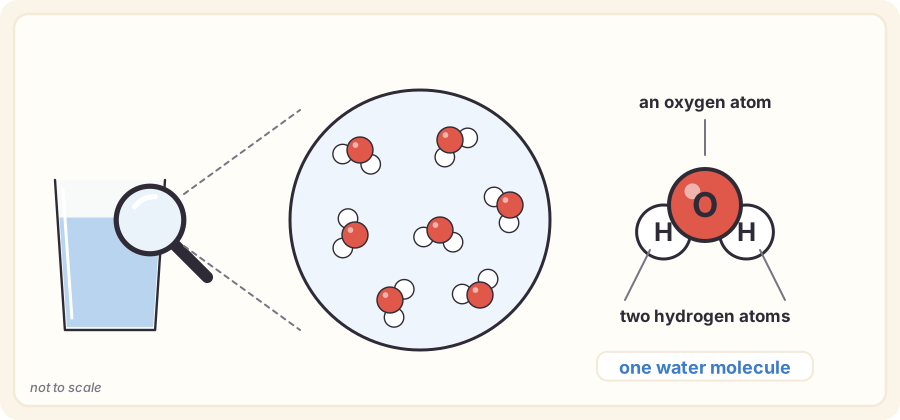
This picture is not to scale. A real water molecule is far too small to see with any magnifying glass, and atoms are not really coloured balls. The colours are only a way to tell the atoms apart: in this course oxygen is always red and hydrogen is always white.
Remember the tiny moving particles from Tiny Moving Particles? In water, each of those particles is one water molecule. When water boils, the molecules fly apart from each other, but each molecule stays whole. Steam is still made of water molecules.
Why do the atoms hold on to each other at all? That is a story for a later level. For now, it is enough to know that they do.
Molecules of one element
A molecule can also be made of atoms of the same element. The oxygen in the air you breathe is not made of single oxygen atoms. Its atoms go around in pairs: two oxygen atoms joined into one oxygen molecule. Nitrogen, the gas that makes up most of the air, goes around in pairs too.
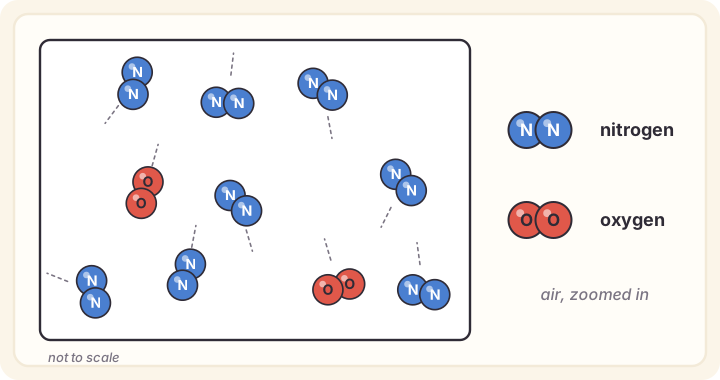
Not every atom joins up into small groups. The helium in a party balloon is made of single helium atoms, each one on its own. And in a piece of gold or iron, the atoms don't form small groups at all. They pack together into one huge crowd of atoms.
Try it at home
- Take some grapes (for oxygen atoms) and some smaller berries, such as blueberries (for hydrogen atoms), and a few toothpicks.
- Join two blueberries to one grape with toothpicks, one on each side. You have built a model of a water molecule.
- Now join two grapes together. That is a model of an oxygen molecule from the air.
- Build three water molecules and put them side by side. They are all exactly alike, just like real water molecules.
The fruit is only a model, of course: real atoms are not fruit, and toothpicks are not what holds them together.
Careful
Toothpicks are sharp. Keep them away from small children, and don't eat fruit that has been on the floor.
Words to know
- molecule - a small group of two or more atoms joined together
Big idea
Atoms can join up into small groups called molecules. A water molecule is two hydrogen atoms and one oxygen atom joined together, and the oxygen in the air is made of pairs of oxygen atoms.