Pulling Mixtures Apart
Mei's grandmother drops a box of steel pins on the beach. They fall into the sand and disappear. Picking them out one by one would take all afternoon, so Mei fetches a magnet. How can you get the parts of a mixture back out again?
Use a property where the parts are different
In the Pure or Mixed? lesson we saw that the parts of a mixture keep their own properties. That is the key to pulling them apart. Find one property where the two parts are different, and use it.
A magnet pulls steel pins, but not sand, so Mei's magnet lifts the pins out and leaves the sand behind. Here are four common ways to separate a mixture, each using a different property.
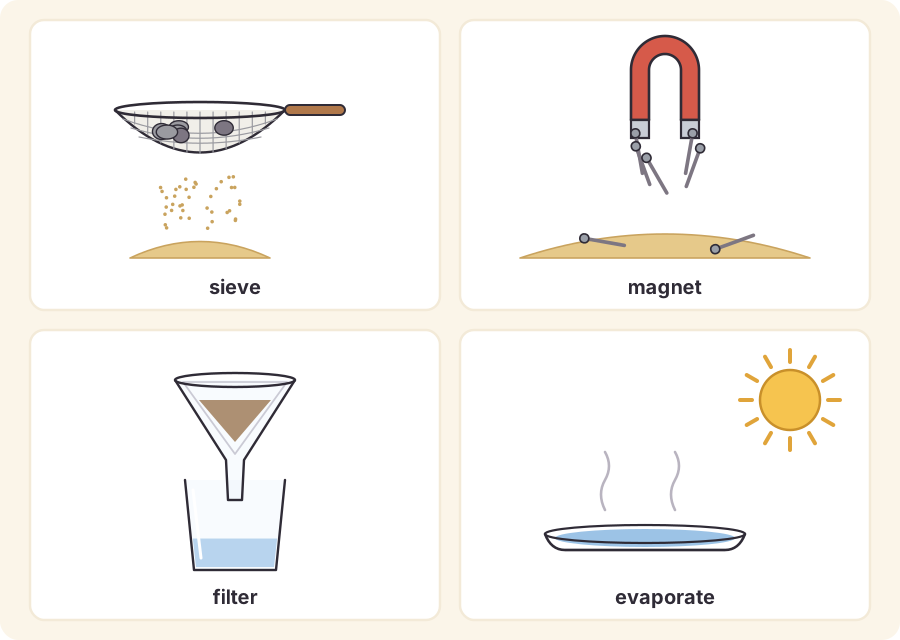
- A sieve separates by size. Small bits fall through the holes and big bits stay on top. A colander for pasta is a sieve too.
- A magnet separates things made of iron or steel from everything else.
- A filter separates bits of a solid from a liquid. It is a sheet with holes too tiny to see, like a coffee filter or a paper towel.
- Evaporating separates a solid that has dissolved in a liquid.
Filtering muddy water
Pour muddy water through a coffee filter in a funnel. The water that drips out at the bottom is clear, and the mud and sand are left on the paper. The holes in the paper are small enough to let the tiny water particles through, but too small for grains of sand.
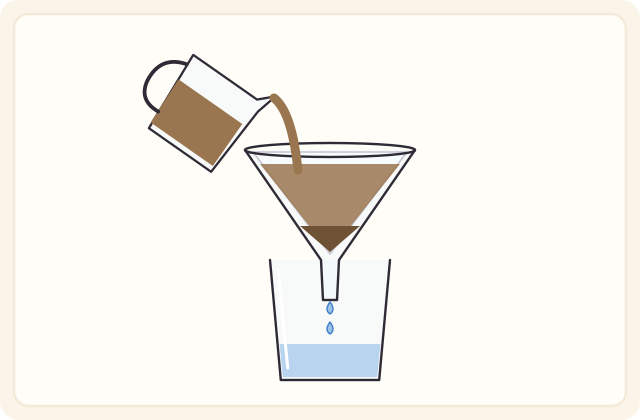
But a filter can't take salt out of sea water. In the Where Does the Sugar Go? lesson we saw that salt dissolves: its particles spread out between the water particles, and they are just as tiny. They go straight through the filter with the water.
Letting the water go
To get dissolved salt back, take the water away instead. In the Evaporating and Condensing lesson we saw that water slowly evaporates into the air, even without boiling. Leave salty water in a shallow dish in a warm, sunny place. Over a few days the water evaporates, but the salt does not. White salt crystals are left in the dish.
This is how a lot of sea salt is made: in hot places, sea water is let into wide, shallow ponds, and the sun does the rest.
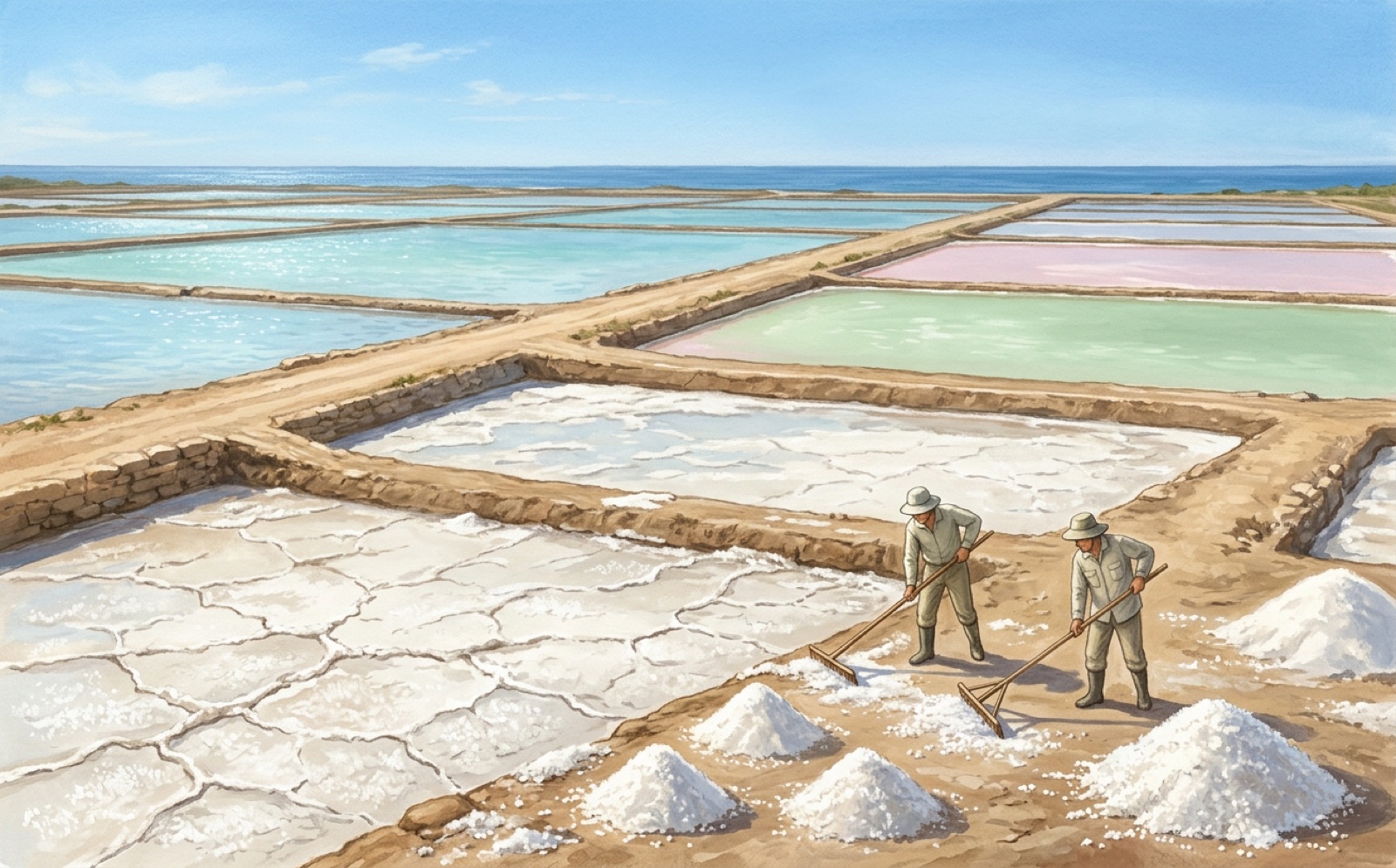
Picture: an illustration of salt ponds by the sea.
Try it at home
- Stir a spoonful of salt and a spoonful of sand into a glass of warm water.
- Put a coffee filter or a folded paper towel in a funnel (or over a jar, held with a rubber band), and pour the mixture through.
- Pour the clear water that comes through into a shallow plate, and leave it on a sunny windowsill for a few days.
You should see sand left on the filter, and white salt crystals on the plate once the water has gone: the sand doesn't dissolve, and the salt doesn't evaporate.
Careful
Don't taste the water or the salt from this experiment.
Words to know
- separate - to take the parts of a mixture apart again
- sieve - a tool with holes that lets small bits through and keeps big bits
- filter - a sheet with tiny holes that lets a liquid through and keeps bits of solid behind
Big idea
The parts of a mixture keep their own properties, so you can pull them apart by using a property where they differ: size for a sieve, iron for a magnet, dissolving or not for a filter, and evaporating for salt in water.