Elements: One Kind of Atom
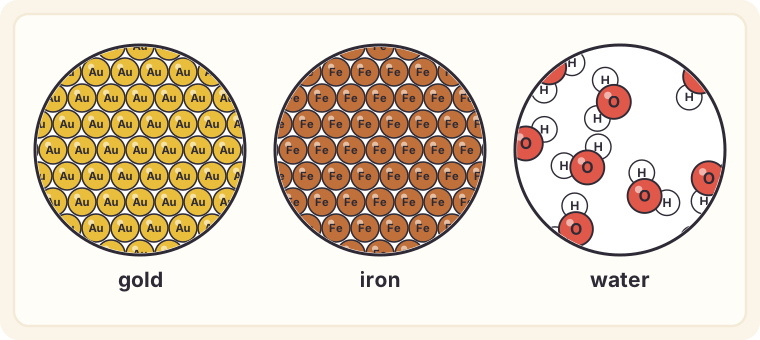
Mei's grandmother has a ring of pure gold. Mei has a glass of water. Both are made of atoms, as we saw in Cut It in Half Again. But if you could look at the atoms in each one, you would see a big difference. Every atom in the pure gold is the same kind of atom. The water has two different kinds. What makes atoms different kinds, and how many kinds are there?
The number that decides
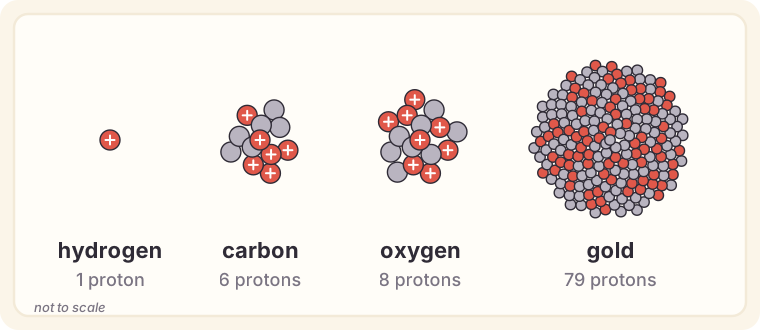
In Inside an Atom we saw that every atom has protons in its nucleus. The number of protons is what decides which kind of atom it is. An atom with 1 proton is always hydrogen. An atom with 6 protons is always carbon. An atom with 8 protons is always oxygen, and one with 79 protons is always gold. Change the number of protons and you have a different kind of atom.
Elements
A substance made of only one kind of atom is called an element. Gold is an element: all its atoms have 79 protons. Iron is an element, and so is the oxygen gas in the air.
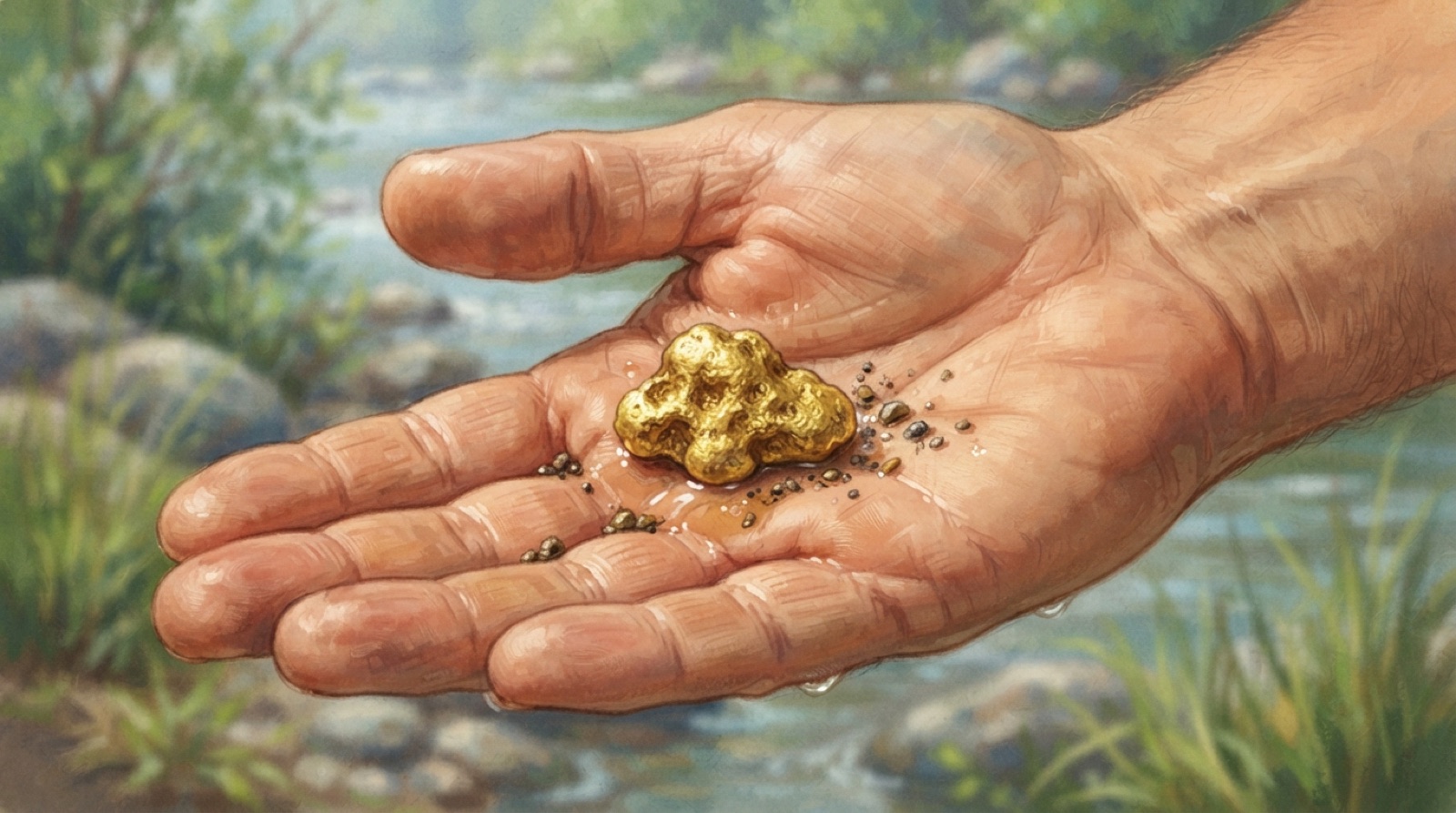
Picture: an illustration of a gold nugget found in a river.
Water is not an element. Each tiny particle of water has two kinds of atom in it, hydrogen and oxygen. Table salt is not an element either: it has two kinds of atom, called sodium and chlorine. Most things around you are like water and salt. They are made of a few elements joined together or mixed.
How many are there?
Scientists know about 118 elements. About 90 of them are found in nature. The rest have only been made in laboratories, often just a few atoms at a time, and many fall apart within seconds.
It may seem strange that everything in the world comes from so few. But think of the 26 letters of the English alphabet. They are enough to write every word in every book. In the same way, about 90 kinds of atom are enough to make every rock, river, plant and person.
The idea that each element has its own kind of atom comes from John Dalton, in 1808. He was the first to say that all the atoms of one element are alike, and different from the atoms of every other element.
Try it at home
Go on an element hunt in your kitchen.
- Find some kitchen foil. It is almost pure aluminium.
- Find an iron nail or a steel spoon. Steel is mostly iron.
- Find a pencil. Its grey "lead" is not lead at all: it is mostly a form of carbon, mixed with a little clay.
- Look for copper: ask an adult to show you the inside of an old electric cable (unplugged!). The orange wires are copper.
Each of these is mostly one element. Water, salt and sugar are not elements: each one has more than one kind of atom.
Words to know
- element - a substance made of only one kind of atom, like gold, iron or oxygen
Big idea
The number of protons in an atom decides which kind of atom it is. A substance made of only one kind of atom is an element. About 118 elements are known, and about 90 of them make up everything in nature.