Nothing Disappears
Sam's family has a campfire. They start with a big pile of heavy logs. In the morning, all that is left is a small heap of grey ash that fits in a cup. Where did all that wood go? Was it destroyed by the fire?

Picture: an illustration of a campfire in the evening, and what is left of it the next morning.
The missing mass
Mass is how much stuff there is in something (in What Is Matter? we saw that everything made of matter has mass). The logs had a lot of mass, and the ash has very little. So it looks as if most of the wood simply disappeared.
But in What Is Fire? we saw what burning really does: the fuel reacts with oxygen from the air and turns into new products, mostly carbon dioxide and water vapour. Those are gases. They rose up with the smoke and spread out into the sky. The wood didn't vanish. Most of it turned into gases that you can't see, and only a little was left behind as ash.
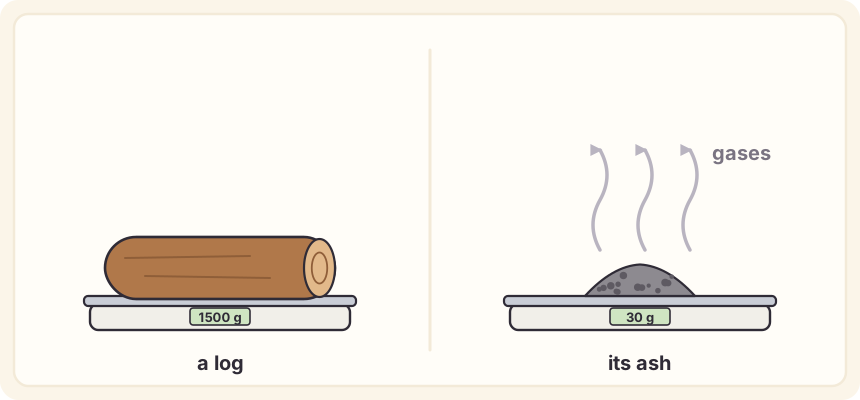
Weighing everything
How could anyone check this? You would have to catch every bit of gas and weigh it too. In the 1770s, a French chemist called Antoine Lavoisier did something like that. He made reactions happen inside closed glass containers, so no gas could get in or out, and he weighed the containers very carefully before and after.
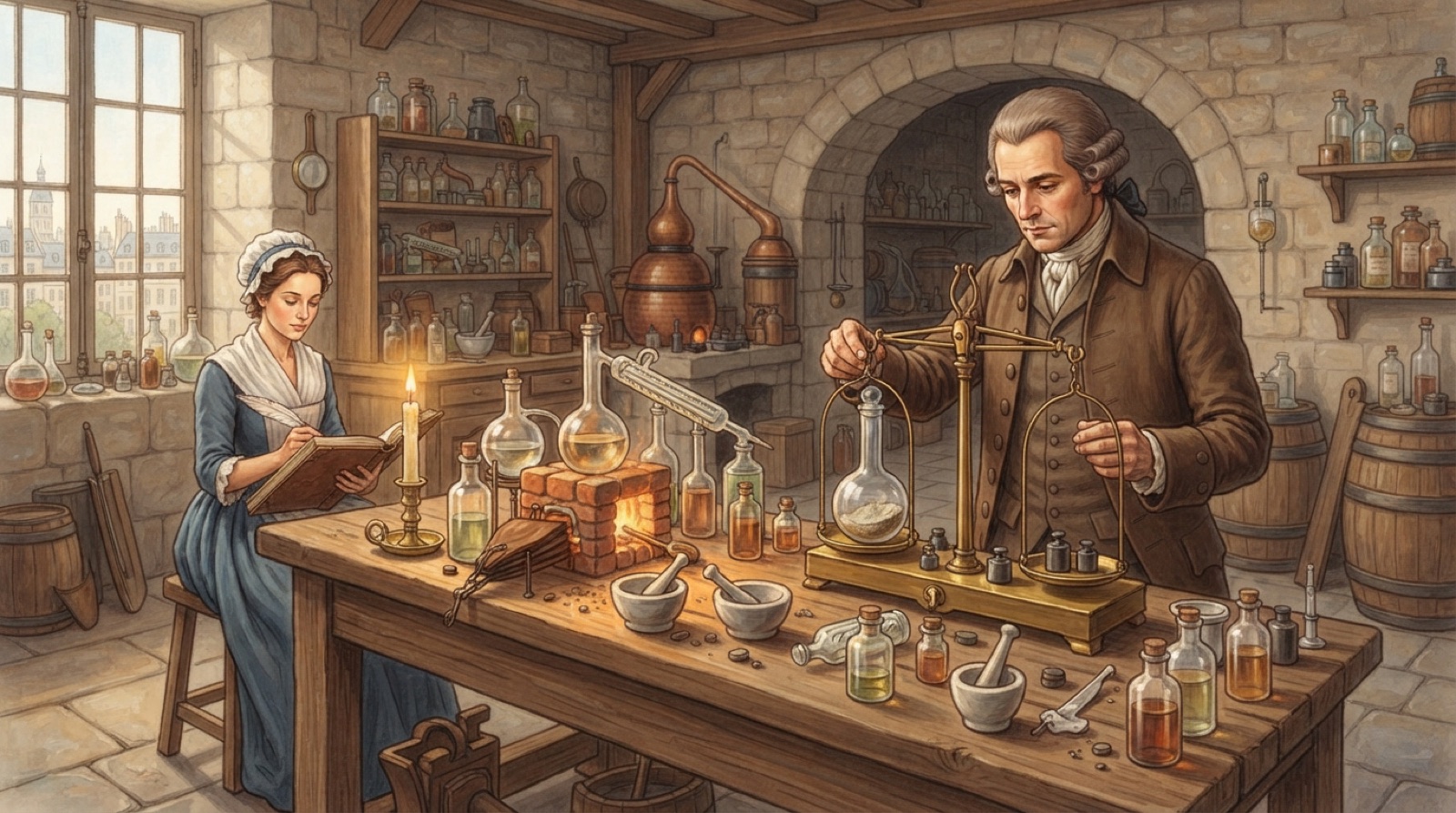
Picture: an illustration of Antoine Lavoisier weighing in his laboratory. His wife, Marie-Anne Paulze Lavoisier, worked with him: she wrote down the experiments and drew the equipment.
Again and again, the total mass inside the container did not change, even though substances turned into other substances. Lavoisier wrote this down as a rule in his book of 1789: in a chemical reaction, nothing is made from nothing, and nothing is lost.
Today we call this rule the conservation of mass. "Conserved" means kept: the mass of the products is the same as the mass of the reactants.
Why it sometimes looks wrong
When an iron nail rusts, it gets heavier. That also looks like the rule is broken, until you remember that the rust is made from iron and oxygen and water. The extra mass came from the air and the water. Whenever a reaction seems to gain or lose mass, a gas has come in or gone out without being weighed.
Try it at home
- Pour a little vinegar into an empty plastic bottle.
- Put two spoons of baking soda inside a balloon, and stretch the neck of the balloon over the top of the bottle, letting it hang to one side so no powder falls in yet.
- Put the whole thing on a kitchen scale and write down the number.
- Lift the balloon so the baking soda falls into the vinegar. Watch it fizz and fill the balloon.
- Look at the scale again.
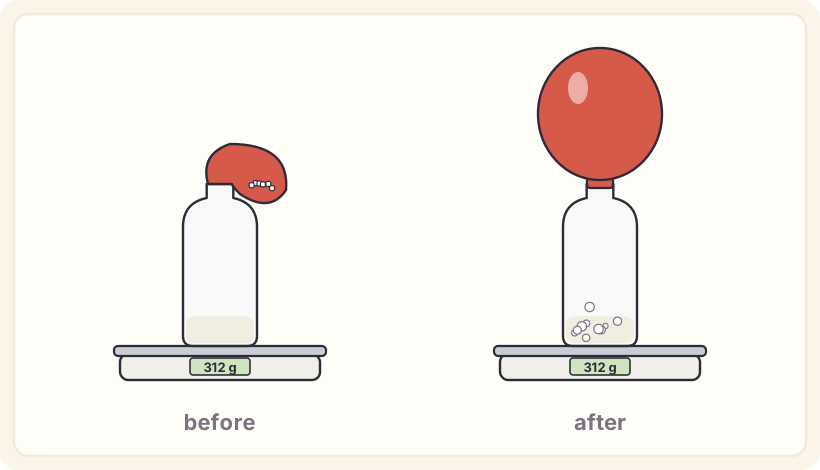
The reading stays almost the same: the new gas is trapped in the balloon, so it is still being weighed. (A very blown-up balloon can make the reading drop a tiny bit, because the air pushes up on it a little, the way water pushes up on a swimmer.) Now take the balloon off and let the gas out. The reading goes down, because some of the mass has floated away as gas.
Careful
Keep balloons away from small children, and wipe up any spilled vinegar.
Words to know
- conservation of mass - the rule that in a chemical reaction the total mass stays the same: nothing is made from nothing, and nothing is lost
Big idea
A chemical reaction changes what stuff is, but not how much of it there is. When mass seems to appear or disappear, a gas has slipped in or out.