Pure or Mixed?
Ana pours herself a bowl of breakfast: oats, raisins, nuts and milk. She can see every part, and she could pick the raisins out one by one if she wanted to. Then she drinks a glass of orange juice. The carton says "100% pure orange juice". Is the juice made of one kind of stuff, like her breakfast is made of several? And why do chemists use the word "pure" more strictly than a juice carton does?
A mixture: two or more kinds of stuff
Ana's breakfast is a mixture: two or more different kinds of stuff put together, but not changed. Each part keeps its own properties. In the Materials and Their Properties lesson we saw that a property is something you can notice or test about a material, like its colour or whether it is hard. The raisins are still sweet and soft. The nuts are still hard. Nothing new has been made.
A mixture can have its parts in any amounts. Ana could add more raisins or fewer nuts, and it would still be her breakfast. And often you can get the parts back out again (the lesson Pulling Mixtures Apart shows how).
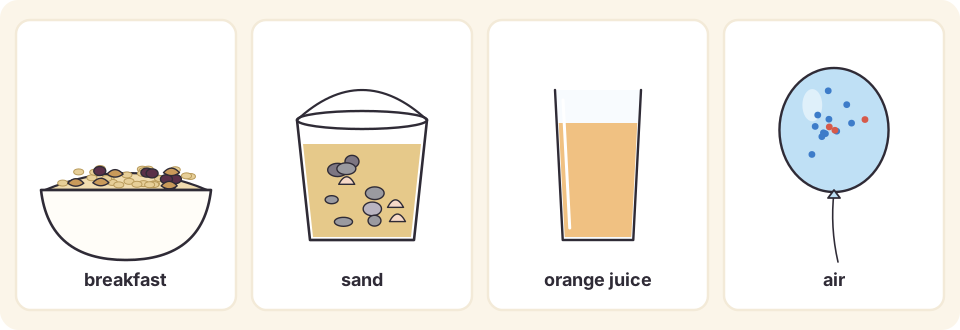
Some mixtures are easy to see, like sand with pebbles in it. Others are not. Air is a mixture of gases: about four-fifths of it is a gas called nitrogen, about one-fifth is a gas called oxygen, and there is a little of some other gases too. Orange juice is a mixture of water, sugars, tiny bits of fruit and many other things. You can't see the parts, but they are there.
A pure substance: only one kind of stuff
A pure substance is made of only one kind of stuff, all the way through. Water with nothing else in it is a pure substance. So is sugar, so is table salt, and so is the gold in a gold ring (if it is real, pure gold). Every bit of a pure substance is the same as every other bit. A pure substance also has fixed properties: pure water always freezes at 0 °C, and pure gold always has the same colour.
So the juice carton uses "pure" in the everyday way: "nothing else was added". A chemist would call orange juice a mixture.
What the particles show
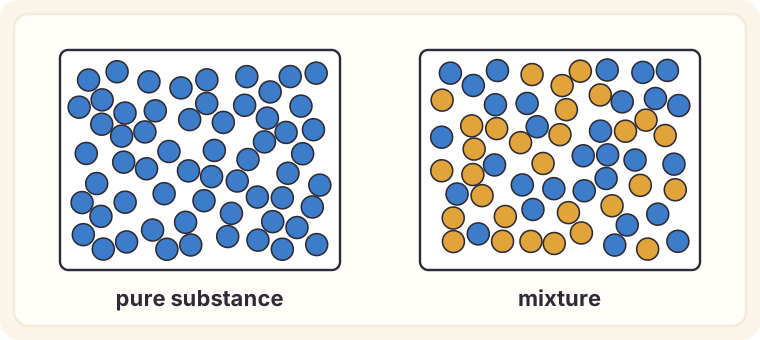
In the Tiny Moving Particles lesson we saw that all stuff is made of tiny particles, far too small to see. This gives a simple way to tell the two apart. In a pure substance, all the particles are the same kind. In a mixture, there are two or more kinds of particles, jumbled together.
Try it at home
- Put a spoonful of rice and a spoonful of dried lentils (or beans) in a bowl, and stir.
- Look closely. Is the rice still rice? Are the lentils still lentils?
- Add another spoonful of rice. Is it still a mixture of rice and lentils?
You should see that both parts keep their own shape and colour, and that the mixture works with any amount of each. That is what makes it a mixture.
Words to know
- pure substance - stuff that is only one kind of stuff all the way through, with only one kind of particle, like pure water or salt
- mixture - two or more substances put together without changing them, like air, sea water or a salad
Big idea
Most of the stuff around you is a mixture: two or more substances put together, each keeping its own properties. A pure substance is only one kind of stuff, all the way through.