Compounds: Something New
You probably eat a little table salt every day. Now here is something strange. Salt is made of two elements. One is sodium, a soft, shiny metal so wild that it fizzes and can burst into flame when it touches water. The other is chlorine, a yellow-green gas that is poisonous to breathe. How can a metal like that and a poison gas make something you sprinkle on your food?
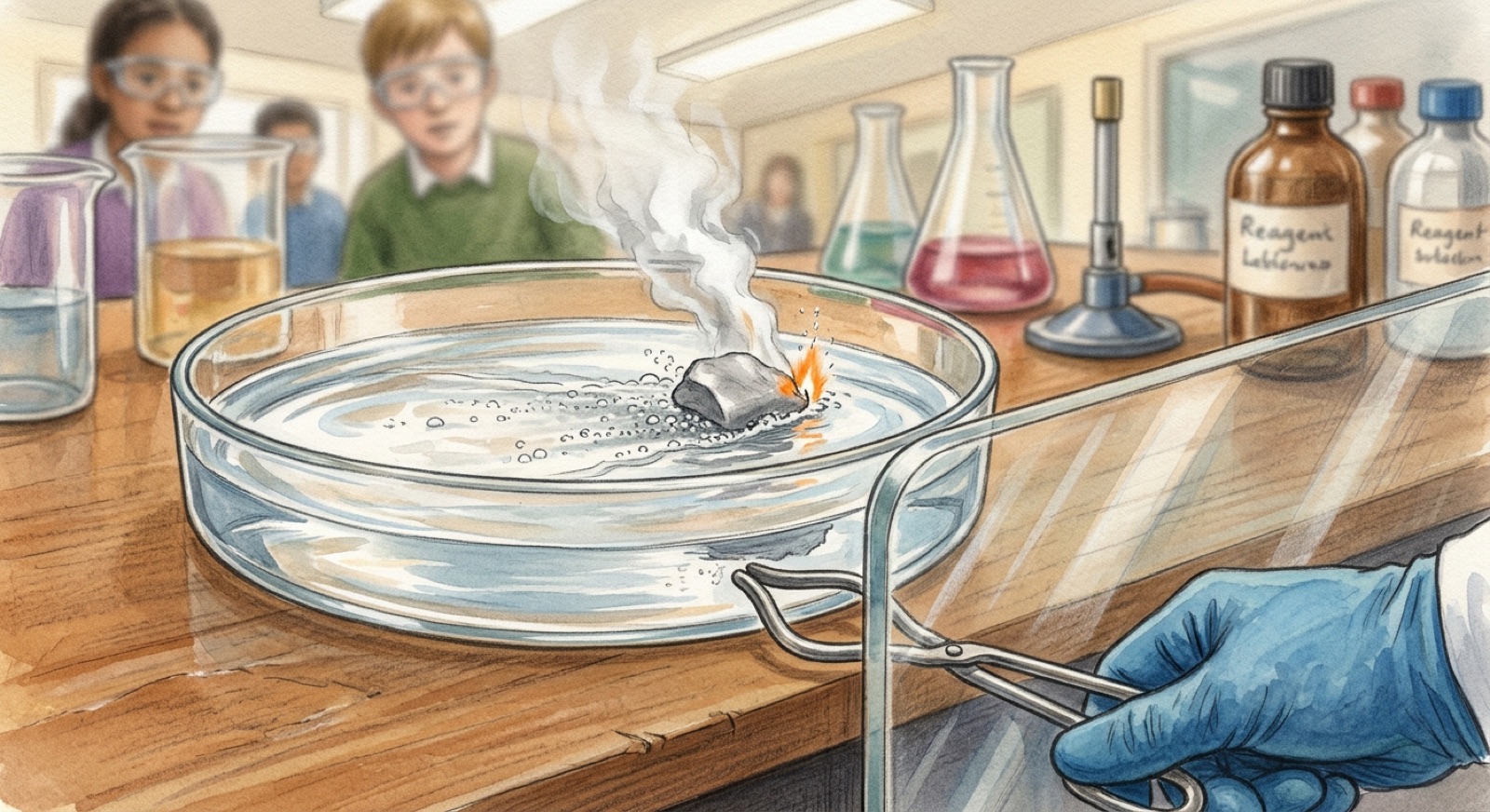
Picture: an illustration of a teacher dropping a tiny piece of sodium into water, behind a safety screen. Never try this yourself.
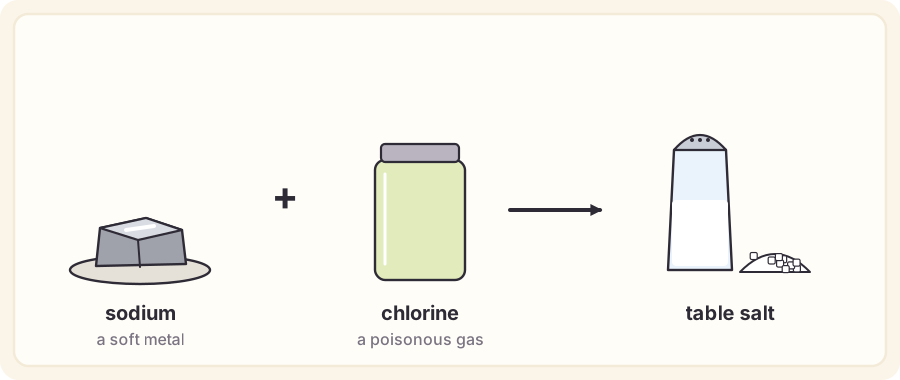
Different elements, joined up
In When Atoms Join Up we saw that atoms can join together. When atoms of different elements join up, they make a compound. A compound is a substance made of two or more different elements joined together.
Salt is a compound of sodium and chlorine. Water is a compound too: every water molecule is two hydrogen atoms and one oxygen atom joined together. The oxygen in the air is not a compound, even though its atoms go around in pairs, because both atoms in the pair are oxygen. A compound always has at least two different elements.
The surprising part is this: a compound is a new substance with its own properties. It does not keep the properties of the elements it is made of. Sodium is a metal and chlorine is a poisonous gas, but salt is neither. It is a white, crunchy, harmless crystal that dissolves in water. Water is another good example. Hydrogen is a gas that burns, and oxygen is a gas that helps things burn. Joined together as water, they make a liquid we use to put fires out.
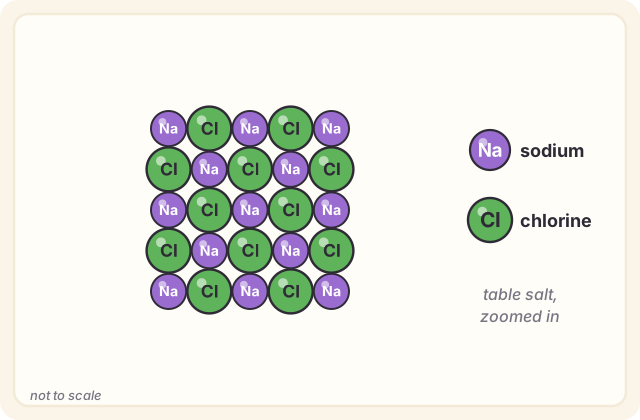
Salt does not come in small molecules like water. In a salt crystal, sodium and chlorine stack together in a huge, regular block, one sodium for every chlorine. That is why salt crystals have flat sides and square corners.
A compound is not a mixture
In Pure or Mixed? we met mixtures, like sand and salt stirred together. A mixture and a compound can sound alike, but they are very different.
In a mixture, each part keeps its own properties, and you can pull the parts apart again with tricks like a sieve, a filter or a magnet, as we saw in Pulling Mixtures Apart. In a compound, the elements are joined into something new, and none of those tricks will separate them. Getting them apart takes another chemical reaction.
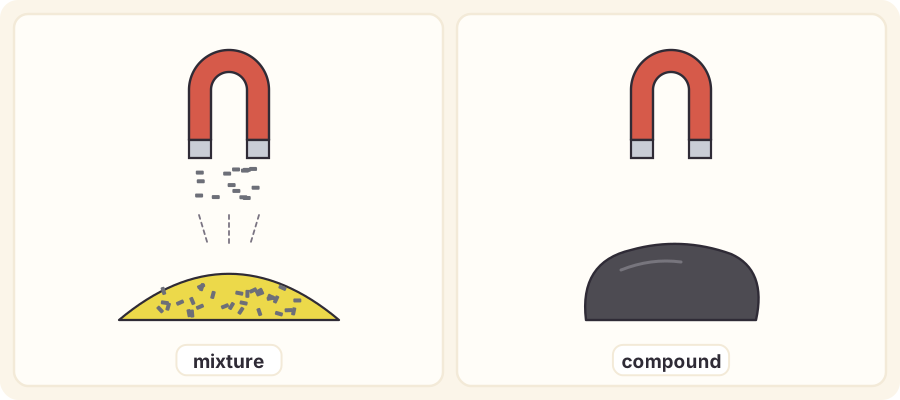
A famous school example uses iron and a yellow powder called sulfur. Stirred together, they are a mixture: a magnet pulls the iron straight back out. Heated together in a laboratory (never at home), they react and make a new compound called iron sulfide. Now a magnet does nothing to it, because there is no loose iron left to pull.
Try it at home
- Stir half a spoon of salt and half a spoon of ground pepper together in a dry glass. That is a mixture: you can still see both.
- Pour in some water and stir. The salt dissolves, and most of the pepper floats on top. The mixture comes apart.
- Now look at the salt itself. No trick in your kitchen can get the sodium or the chlorine out of it. That is because salt is a compound, not a mixture.
Careful
Only use salt and pepper from the kitchen. Never mix cleaning products to see what happens: some of them make poisonous gases.
Words to know
- compound - a substance made of two or more different elements joined together, with its own new properties
Big idea
When different elements join up they make a compound, a new substance that can be nothing like the elements in it. Unlike a mixture, a compound can't be pulled apart with a sieve, a filter or a magnet.