When Does a Heap Begin?
Amir and his grandmother are at the beach. She picks up one grain of sand and asks, "Is this a heap of sand?" "Of course not," says Amir. "And if I add one more grain?" Still not a heap. "Can adding just one grain ever turn something that isn't a heap into a heap?" Amir thinks about it and says no. His grandmother smiles. "Then a million grains aren't a heap either." But Amir can see a heap right in front of him. What went wrong?
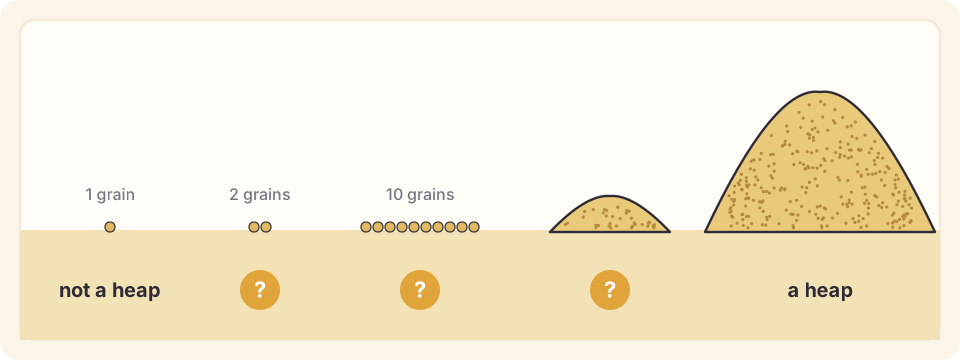
The puzzle of the heap
This puzzle is about 2,400 years old. It is said to come from the Greek philosopher Eubulides of Miletus. Here it is set out, step by step:
One grain of sand is not a heap.
Adding one grain to something that is not a heap never makes it a heap.
So two grains are not a heap, and three are not, and so on.
So a million grains are not a heap.
Each line seems true. Each step seems to follow. But the end is plainly false. So something must give.
Vague words
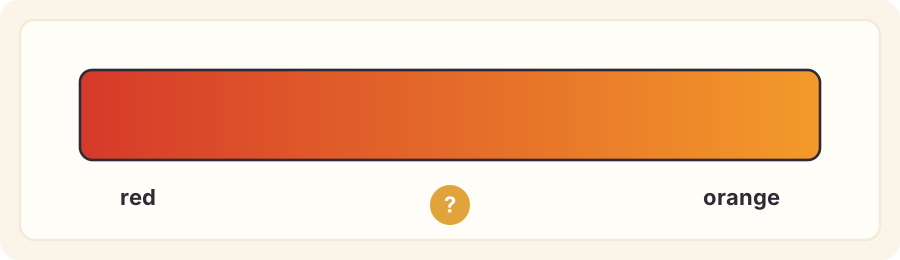
The trouble is the word "heap". There is no exact number of grains where a heap begins. A word like this, with no sharp line between where it fits and where it doesn't, is called vague. Most everyday words are vague: tall, old, heap, crowd, red, child. Between the clear cases there are cases in between, where it isn't clear either way.
Three answers
There is a sharp line; we just don't know where it is. Some philosophers say that one grain really does make the difference somewhere - say, at grain 3,517 - but nobody can ever know which. The puzzle for this answer: what could make it that grain, and not the one before?
The in-between cases are neither. A pile in between isn't clearly a heap or clearly not a heap. So the second line of the puzzle is not simply true: for the cases in between, it is neither true nor false. The puzzle for this answer: where do the in-between cases start? That seems to need a sharp line too.
Vagueness is in our words, not in the world. The sand is just sand, grain by grain. "Heap" is a loose word we made for everyday use, and it was never meant to be exact. The puzzle for this answer: then is there no fact about whether Amir is looking at a heap?
When people need a sharp line, they draw one on purpose. Many countries treat people as adults from their 18th birthday, not because a person changes overnight, but because a law needs a line.
Try it at home
- Take a handful of rice or dried beans and pour them out one at a time.
- Ask someone to say "heap" when they think it has become a heap.
- Try it again with another person. Did they say "heap" at the same moment?
Words to know
- vague - having no sharp line between where a word fits and where it doesn't, like "tall" or "heap"
Big idea
One grain never seems to make a heap, yet heaps exist. The puzzle shows that most words are vague, and nobody yet agrees whether the vagueness is in the world, in our words, or only in what we know.