A World Like Clockwork
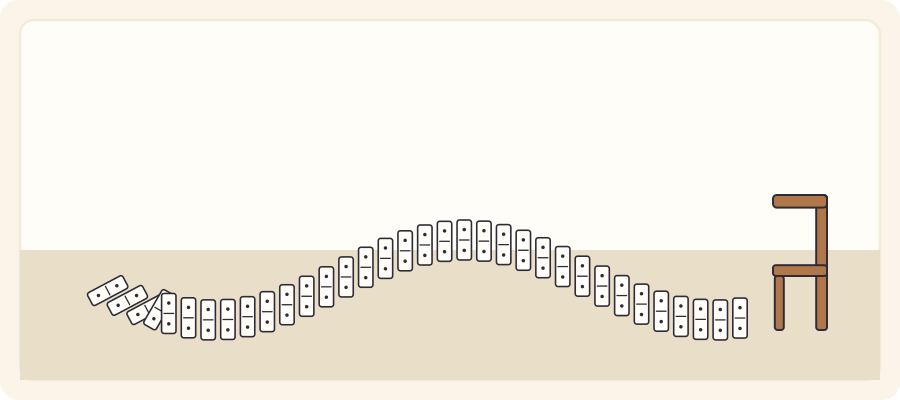
Sam has set up a hundred dominoes in a long, winding line across the floor. Before he tips the first one, his sister Mei looks at the line and says, "The last one will fall right next to the chair leg." She is right. Once the dominoes are in place, everything that happens after the first push is fixed. Could the whole world be like that?
Every event has a cause
In the What Is a Cause? lesson we saw that causes make chains: the knock caused the fall, and the fall caused the break. Now suppose that everything that happens has causes like that, and that the causes always work by the same rules - what scientists call the laws of nature. Then each moment of the world is fixed by the moment before, as each domino is fixed by the one before it.
The idea that everything that happens is fixed by what came before, together with the laws of nature, is called determinism. It means that the whole future, down to the last detail, already follows from how the world is right now.
A mind that knew everything
In 1814 the French scientist Pierre-Simon Laplace put it like this. Imagine a mind that knew, at one moment, where every tiny bit of the world was and how it was moving, and also every law of nature. If it were clever enough to work it all out, nothing would be uncertain for it. It could tell the whole future, and the whole past, the way Mei could tell where the last domino would fall.
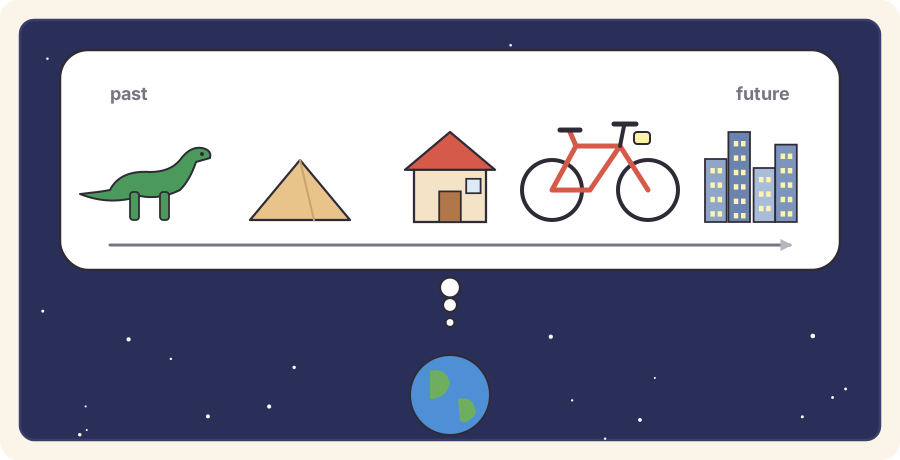
No real mind could ever do that. The point is not that someone could know the future, but that, if determinism is true, there would be a future there to know, already fixed.
Is the world like that?
For determinism for hundreds of years, science has found causes for things that once seemed to happen for no reason - eclipses, illnesses, earthquakes. Each time, the world turned out to follow rules. Perhaps everything does.
Against it many physicists today think that at the very smallest scale, some events are not fixed by what came before. When a tiny bit of matter breaks apart, for example, the laws may say only how likely it is to happen in the next hour, not when it will happen. Other physicists disagree, and the question is still open.
Either way, determinism leads to a big question about us. If everything is fixed by what came before, what about our own choices? That is the question of the next module.
Try it at home
- Line up some books, dominoes or cards so that each knocks over the next.
- Before you tip the first, say where the last one will land.
- Write down one thing in your life you think was fixed before it happened, and one thing you think wasn't. What makes the difference?
Words to know
- determinism - the idea that everything that happens is fixed by what came before, together with the laws of nature
Big idea
If every event is caused by what came before, the world is like a line of dominoes and the whole future is already fixed. Whether the world really is like that is still an open question - and it matters for our choices.