The Ship of Theseus
In the Greek city of Athens, people kept an old wooden ship for hundreds of years. They said it had belonged to Theseus, a hero from their oldest stories. As the years went by, its planks rotted. Each time one rotted, they took it out and put a new plank in its place. In the end, not one of the old planks was left. Was it still the ship of Theseus?
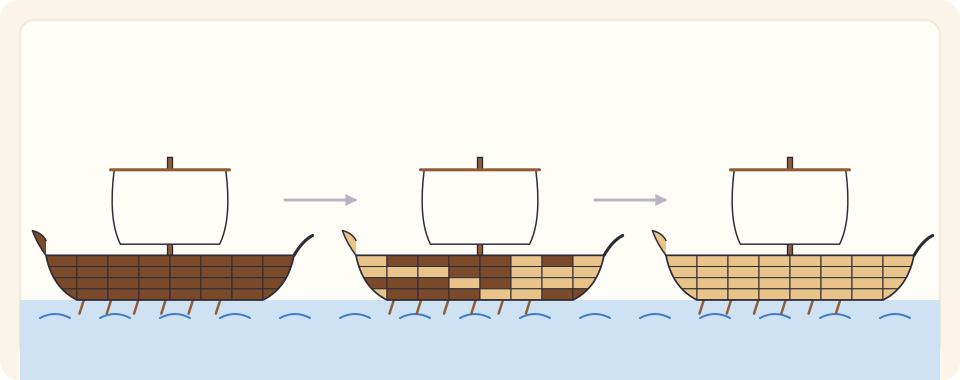
A story to test an idea
The Greek writer Plutarch told this story about 1,900 years ago, around the year 100. He wrote that philosophers argued about it: some said the ship stayed the same ship, and some said it did not.
Nobody needs to rebuild a real ship to think about the question. A made-up or remembered case like this, used to test an idea, is called a thought experiment. Metaphysics uses thought experiments the way science uses real ones: change one thing, and see what we think.
The question is the one from the Two Ways of Being the Same lesson. The new ship is clearly not exactly alike the old one. But is it the same one?
Two answers
Yes, it is the same ship. It was changed slowly, one plank at a time. After each change, everyone agreed it was still Theseus's ship: one new plank doesn't make a new ship. It kept its shape, its name and its job, and the people of Athens kept looking after it. Your bike is still your bike after a new tyre, and still your bike after a new chain.
No, it is a new ship. Nothing of the old ship is left - no wood that Theseus ever touched. If someone said "this is the ship Theseus sailed", they would be wrong: Theseus never stood on any of these planks.
Then a second ship
About 1,550 years later, in 1655, the English philosopher Thomas Hobbes made the puzzle harder. Imagine that someone kept every old plank as it was taken out. At the end, they put the old planks back together, in the same order, and built a ship. Now there are two ships.
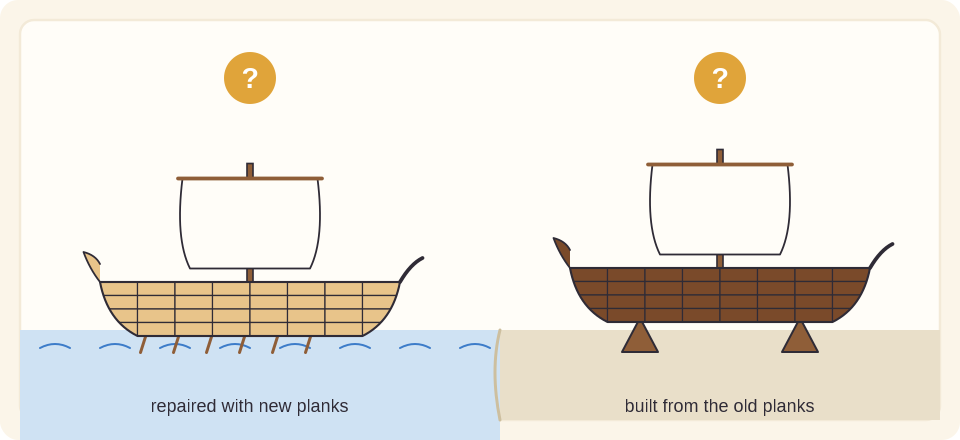
Which one is the ship of Theseus? If what matters is the wood, it is the ship built from the old planks. If what matters is the story of a ship that kept going and was repaired, it is the one in the harbour. They can't both be the one ship of Theseus, because there are two of them. Each answer leaves the other ship with a good claim.
Try it at home
- Think of something that has had parts replaced: a bike, a football team, a school, a band.
- Has every part been replaced? Is it still the same one?
- Write down what you think matters most: the parts, the shape, the name, or the story.
Words to know
- thought experiment - a made-up case used to test an idea, changing one thing at a time
Big idea
If a thing's parts are replaced one by one, is it still the same thing? The Ship of Theseus shows that the parts and the story can point to different answers - and Hobbes's second ship makes us choose.