What Is a Cause?
Ana is reaching for the bread when her arm knocks a glass off the table. It falls and breaks on the floor. Everyone knows what happened: Ana's arm made the glass fall, and the fall made it break. We say "made it happen" all day long, about almost everything. But what does it mean for one thing to make another happen?
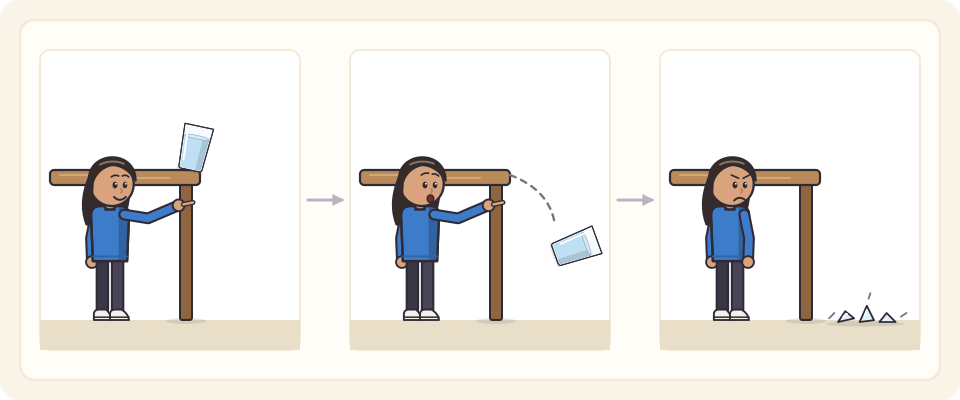
Cause and effect
When one thing makes another happen, the first is called the cause, and what it makes happen is called the effect. The knock is the cause; the glass falling is the effect. Then the fall is a cause too, and the broken glass its effect. Causes and effects make chains.
Not just "after"
As Logic Level 1 showed, one thing coming after another doesn't prove that the first caused the second. The rooster crows before sunrise every morning, but the rooster doesn't make the Sun rise. So what is the difference?
One good test is to ask: would it have happened without it? Without the knock from Ana's arm, the glass would have stayed on the table. So the knock caused the fall. Without the rooster, the Sun would rise all the same. So the rooster's crowing doesn't cause the sunrise.
Many causes for one effect
Now think of a campfire. Nadia strikes a match and lights the dry wood. What caused the fire?
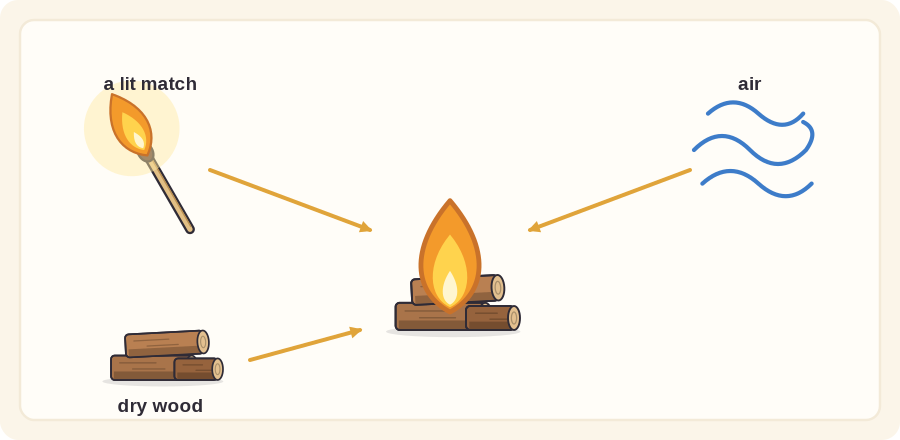
Use the test. Without the match, no fire. Without the dry wood, no fire. Without the air around it, no fire either - a fire needs air to burn. So all three pass the test. Yet if someone asks "What caused the fire?", we answer "Nadia lit it", not "There was air". We usually pick out the cause that was unusual, or that someone did. Air is always there; striking the match was what changed.
Where the test is not enough
The test works well, but not always. Leo and Tom each throw a stone at an old window, at the very same moment, and both stones hit it. The window breaks. Would it have broken without Leo's stone? Yes - Tom's stone would have broken it. And without Tom's stone? Yes, because of Leo's. So by the test, neither stone caused the break. But surely both did. Philosophers are still working on what a cause is, beyond the test.
Try it at home
- Pick something that happened today: you were late, the milk spilled, the plant grew.
- Write down three things that caused it.
- Use the test on each: would it have happened without it? Which one would you call "the" cause, and why?
Words to know
- cause - something that makes another thing happen
- effect - what a cause makes happen
Big idea
A cause is what makes something happen, and a good test is "would it have happened without it?". Most effects have many causes, and the test can be fooled, so what a cause is is still a real question.