Could It Have Been Different?
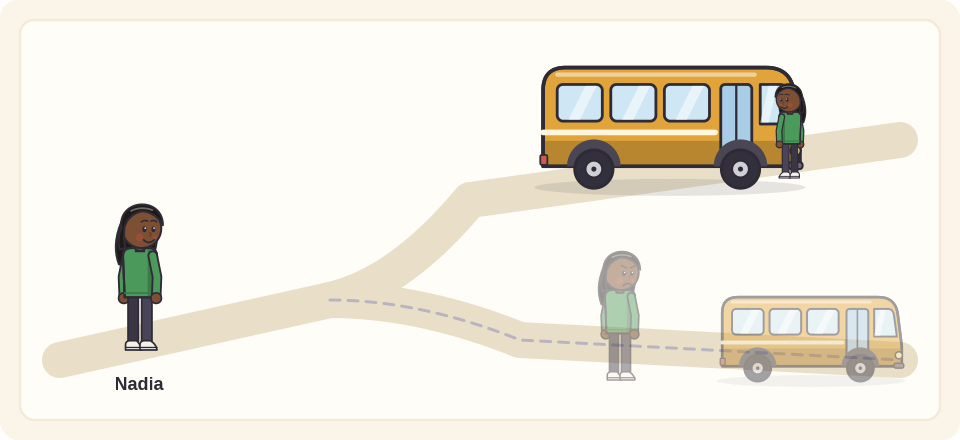
Nadia runs round the corner just as the bus is closing its doors. She jumps on, out of breath. "That was close," she thinks. "I nearly missed it." She didn't miss it - but she could have. Her morning could have gone differently. Other things couldn't: whatever happened, two plus two would still have made four. What is the difference?
Possible, impossible, necessary
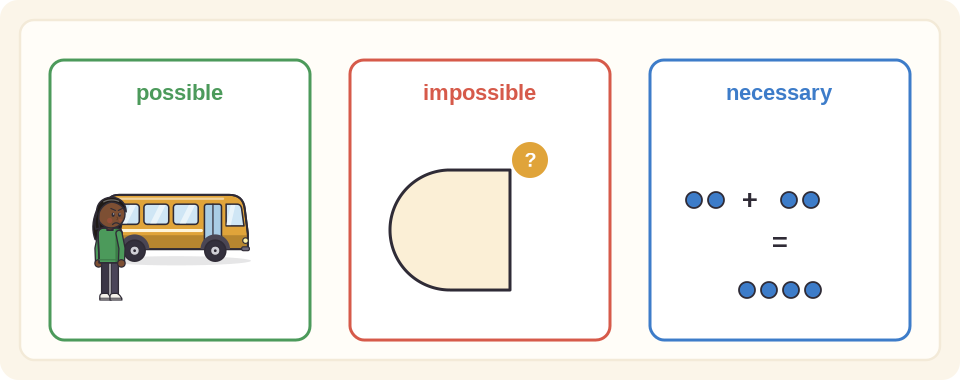
Something that could be, or could have been, is possible. Nadia missing the bus was possible. It didn't happen, but it could have.
Something that couldn't be, however things went, is impossible. A circle that is also a square is impossible. So is a triangle with four sides. It isn't just that nobody has found one: the idea doesn't fit together.
Something that must be, however things went, is necessary. That two plus two make four is necessary. So is the fact that a triangle has three sides. No change in the world could make them otherwise.
Two kinds of possible
People also say a person flying by flapping their arms is impossible. But it is impossible in a different way from a square circle. You can picture someone flying - it happens in dreams and stories, as it did for Mei in the What Is Real? lesson. The laws of nature rule it out; the idea itself is fine. A square circle can't even be pictured clearly. Philosophers keep these two apart: what the laws of nature allow, and what could be at all.
What makes something possible?
"Nadia could have missed the bus" is true. But what makes it true? The missed bus never happened, so it can't be anything in the world.
Possibilities are ways of thinking about this world. When we say Nadia could have missed the bus, we mean that nothing in the idea of it goes wrong, and nothing about Nadia or buses rules it out. The puzzle for this answer: if determinism is true, as the clockwork lesson asked, then everything about the world did rule it out. In what sense could she have missed it?
Every possibility is real somewhere. The American philosopher David Lewis argued, in 1986, that every way the world could have been is a real world, just as real as ours, though we can never visit it. In one of them, someone very like Nadia misses the bus. The puzzle for this answer: almost nobody can believe it. Lewis said that people met it with "an incredulous stare".
Try it at home
- Write down one thing that happened today that could have gone differently.
- Write one thing that is impossible, and one that is necessary.
- Ask a friend to put your three things in the right boxes. Did they agree?
Words to know
- possible - could be, or could have been
- impossible - could not be, however things went
- necessary - must be, however things went
Big idea
Some things could have been different, some couldn't, and some must be. Knowing which is which is easy for two plus two; saying what makes something possible is one of metaphysics' hardest questions.