Things and Their Properties
Kofi has an apple on his desk. It is red, round, sweet and crunchy, and about as heavy as his fist. He leaves it there for a week. Now it is brown, soft and wrinkled. But it is still the same apple - nobody swapped it. So the apple has changed what it is like, and stayed the same apple. What, then, is the apple, if not the red, round, sweet thing it was?
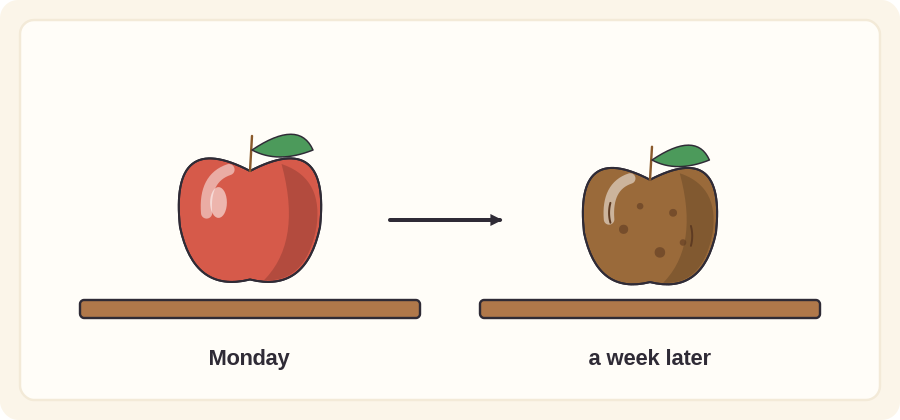
What a thing is like
Everything you can describe has features: its colour, shape, size, weight, taste, smell. A feature like this - something a thing is like - is called a property. Kofi's apple had the properties red, round and sweet. A week later it had the properties brown, wrinkled and soft.
Notice two things. First, one property can belong to many things: the apple is red, and so are a fire engine and a strawberry. Second, one thing can lose a property and gain another, and still be the same thing. That second fact leads to the puzzle.
Take the properties away
Try this in your head. Picture the apple, and take away its colour. Then its taste and smell. Then its shape and size. Then its weight. What is left?
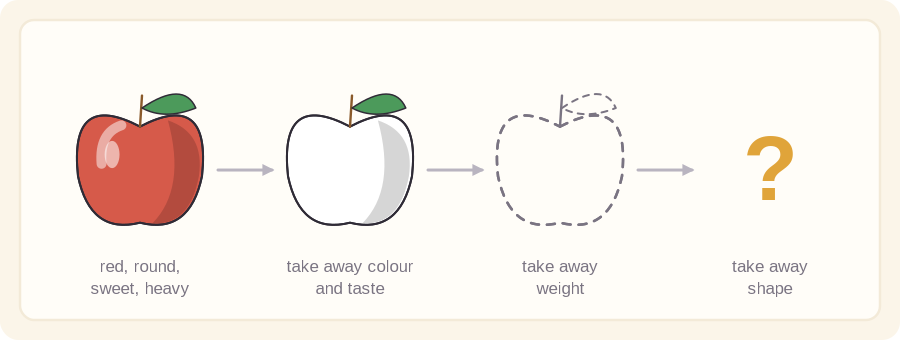
Philosophers have given two answers.
Something is left: the thing that has the properties. The properties must belong to something. The redness doesn't float around on its own; it is the apple's redness. And something has to stay the same while the properties change, or there would be no apple that changed. The English philosopher John Locke, in 1690, called this "something, he knew not what".
The puzzle for this answer: what is this something like? Any answer you give is another property. So the thing under the properties is something nobody can ever describe, or see, or touch. That is a strange thing to believe in.
Nothing is left: a thing is its properties, bundled together. When we look closely, we only ever find properties - redness, roundness, sweetness. The Scottish philosopher David Hume wrote in 1739 that we have no idea of a thing apart from its properties held together. So an apple is a bundle of properties that stay together and change together.
The puzzle for this answer: if the apple is only its properties, then when the properties change, it should be a different bundle - a different apple. How can a bundle change all its properties and still be the same bundle?
Neither answer has won. Each one explains something the other finds hard. The next module comes back to the second puzzle: what makes something the same thing as it changes.
Try it at home
- Pick one thing in your room: a cup, a shoe, a book.
- List ten of its properties.
- Cross out the ones it could lose and still be the same cup, shoe or book. Is any property left that it could never lose?
Words to know
- property - a feature of a thing; something a thing is like, such as its colour, shape or weight
Big idea
A thing can change its properties and stay the same thing. So is a thing something under its properties, or just its properties held together? Both answers have a puzzle, and this one is still open.