Memory and the Self
Mei has a photo of her third birthday. She is blowing out three candles, and her grandmother is laughing. Mei doesn't remember that day at all. Her grandmother remembers it well. Was the little girl in the photo really Mei, if Mei can't remember being her?
As far back as you remember
The English philosopher John Locke had an answer. In 1694 he wrote that a person is the same person as far back as their memory reaches. Your body is not what makes you you; your mind is - above all, your memories of what you did and felt.
To show why, Locke told a thought experiment. Imagine that one morning a prince wakes up in the body of a shoemaker, with all his own memories: his palace, his lessons, his family. The shoemaker wakes up in the prince's body, remembering his workshop. Who is who?
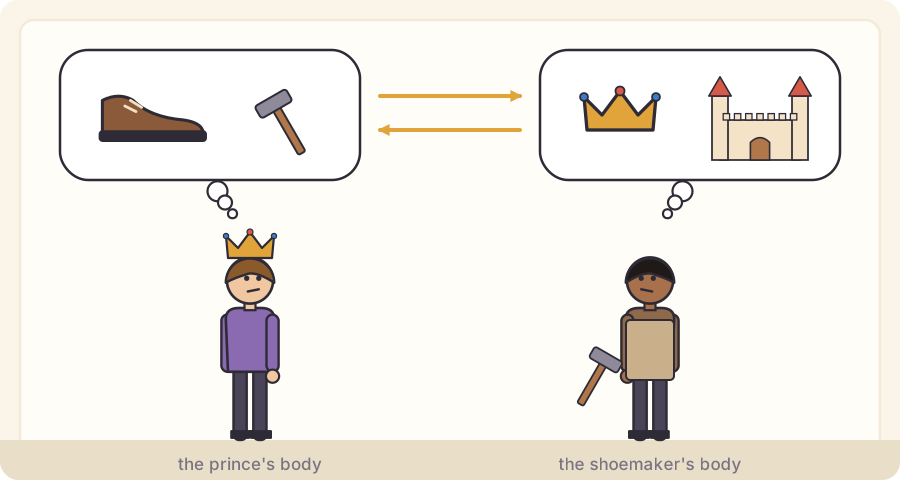
Most people say the prince is now the one in the shoemaker's body: he remembers being the prince, and he would want to go home to the palace. If that is right, then what makes you you follows your memories, not your body.
The brave officer
About 90 years later, in 1785, the Scottish philosopher Thomas Reid answered with a thought experiment of his own. A boy is punished at school for stealing apples. Years later, as a young officer in the army, he captures the enemy's flag in a battle, and he still remembers being punished as a boy. Much later, as an old general, he remembers capturing the flag - but he has forgotten being punished at school.
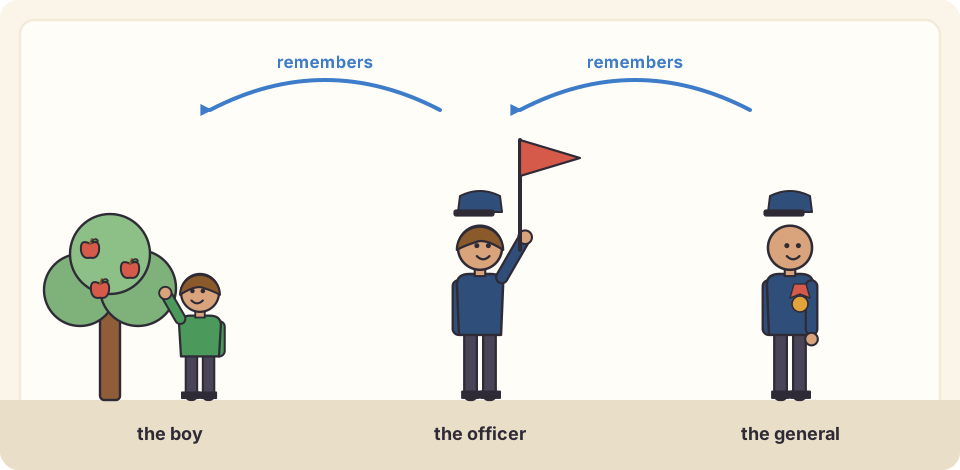
By Locke's answer, the general is the same person as the officer, since he remembers being him. The officer is the same person as the boy. But the general is not the same person as the boy, because he can't remember being him. That can't be right. As the Two Ways of Being the Same lesson showed, "the same one" means one thing, not two. If the general is the officer and the officer is the boy, then the general is the boy.
Some later philosophers mended Locke's answer: what counts is a chain of memories, each link overlapping the next. The general is the boy because the officer links them. The puzzle for the mended answer: Mei's third birthday may not be linked to any memory she has at all. Was it someone else's birthday?
Try it at home
- Write down your earliest memory.
- Then write something you did before it that you know about only from others.
- Was that you? Write down what makes you say yes or no.
Words to know
No new words: this lesson uses personal identity and thought experiment from earlier lessons.
Big idea
Locke said you are the same person as far back as your memory reaches, and his prince and shoemaker seem to show it. Reid's brave officer shows the trouble: memories fade, but "the same one" can't.