Swapping the Factors
Rana knows that 4 × 7 = 28. Does she have to work out 7 × 4 all over again?
Turn the array
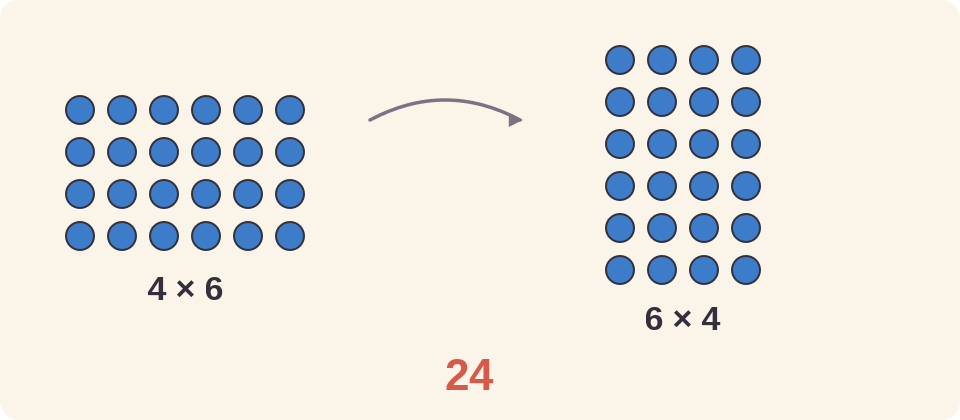
Here is an array with 4 rows of 6. That is 4 × 6.
Turn the paper on its side. Now there are 6 rows of 4. That is 6 × 4.
It is the same array, so it has the same number of dots: 24.
So 4 × 6 = 6 × 4 = 24. You can swap the factors, and the product stays the same.
Half the work
So Rana is right: 7 × 4 is also 28.
This cuts the facts you must learn almost in half.
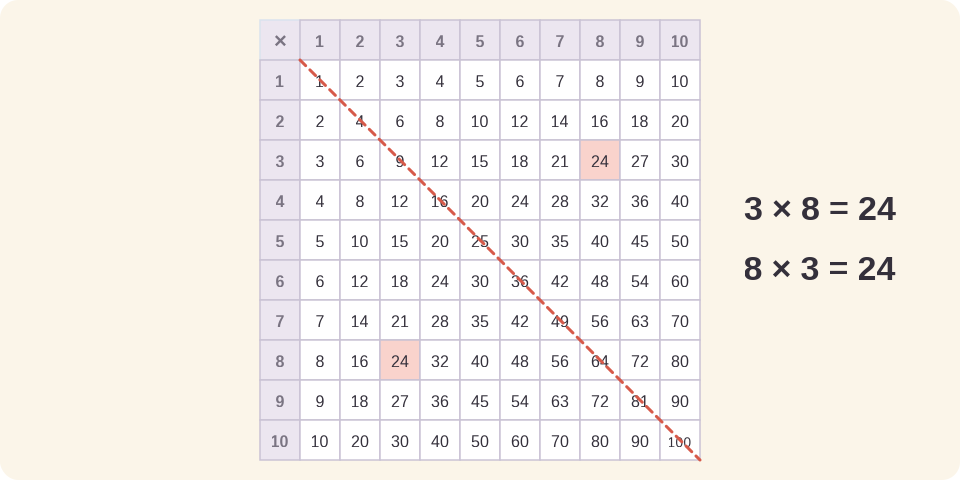
If 3 × 8 seems hard, think 8 × 3. Count by threes eight times, or by eights three times: 8, 16, 24.
In the times table, the products match across the line from corner to corner.
Try it at home
- Lay out 2 rows of 5 coins.
- Turn the rows to make 5 rows of 2. Count again.
- Write both facts: 2 × 5 = 10 and 5 × 2 = 10.
Words in this lesson
- swap - to change places.
Big idea
Swapping the factors keeps the product: 4 × 6 = 6 × 4.