Breaking Apart to Multiply
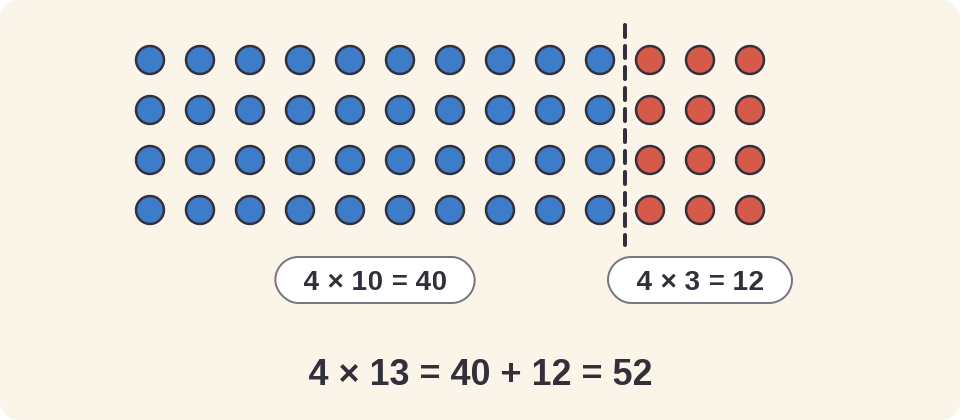
A garden has 4 rows of 13 tulips. 4 × 13 is not in the times table. How can you find it in your head?
Cut the rectangle
Cut the 4 rows of 13 into two parts: 10 and 3.
The big part is 4 × 10 = 40. The small part is 4 × 3 = 12.
Put them back together: 40 + 12 = 52 tulips.
We write it 4 × 13 = (4 × 10) + (4 × 3).
Work out the brackets first: (2 × 5) + (3 × 4) = 10 + 12 = 22.
Any way you like
8 × 15 is 8 × 10 plus 8 × 5. That is 80 + 40 = 120.
Three groups of 24 blocks: 3 × 20 = 60 and 3 × 4 = 12, so 72.
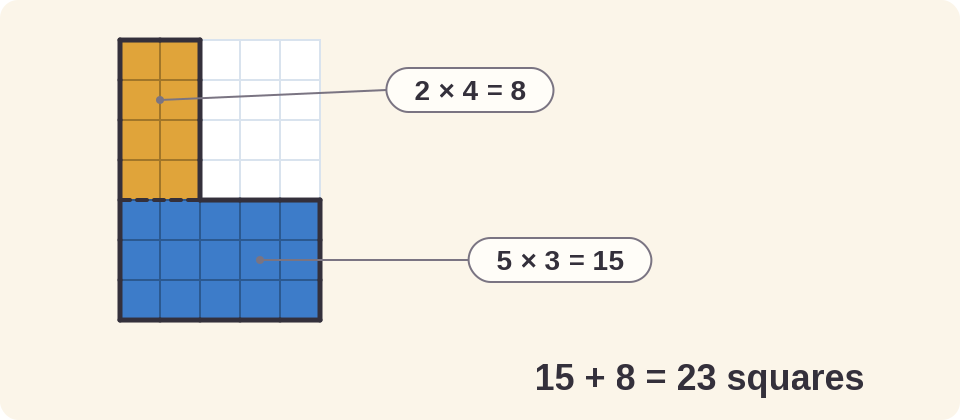
An L-shaped room is two rectangles. Find each area, then add.
With three numbers, multiply in any order. For 5 × 7 × 2, do 5 × 2 = 10 first. Then 10 × 7 = 70.
Try it at home
- Draw 3 rows of 12 dots.
- Draw a line after the tenth dot in every row.
- Find 3 × 10 and 3 × 2, then add. Did you get 36?
Words in this lesson
- brackets - the marks ( ) around a part of a number sentence that we work out first.
Big idea
Break a big multiplication into smaller ones, then add the parts.