A.M., P.M. and the 24-Hour Day
The clock says 7:00. But is it time for breakfast or time for dinner? The clock face cannot tell you!
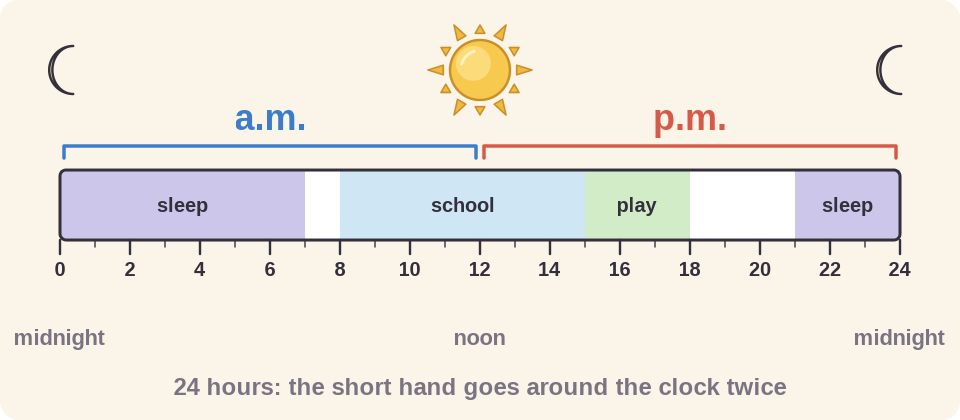
Around the clock twice
A day and a night together are 24 hours.
The short hand goes around the clock twice in that time.
The hours from midnight to noon are a.m.: 7 a.m. is in the morning.
The hours from noon to midnight are p.m.: 7 p.m. is in the evening.
The 24-hour clock
Some clocks, trains and countries count on after noon instead of starting again.
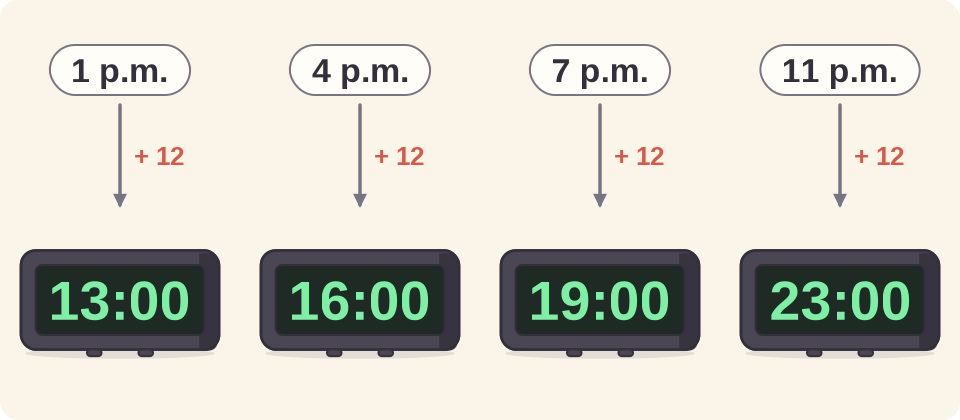
1 p.m. is 13:00, 2 p.m. is 14:00, and so on. Just add 12.
So 4 p.m. is 16:00, and 7 p.m. is 19:00.
If school goes from 8:00 to 13:00, count the hours: 8 to 13 is 5 hours.
Try it at home
- Write three things you did yesterday and the times you did them.
- Mark each one a.m. or p.m.
- Now write the p.m. times on the 24-hour clock by adding 12.
Words in this lesson
- a.m. - the hours from midnight to noon.
- p.m. - the hours from noon to midnight.
Big idea
A day is 24 hours: a.m. before noon, p.m. after; on a 24-hour clock, 4 p.m. is 16:00.