Trying a Simpler Problem
A long log must be cut into 10 pieces. How many cuts are needed? Many people say 10. Are they right?
Start small
Big numbers can hide what is going on. So try small numbers first.
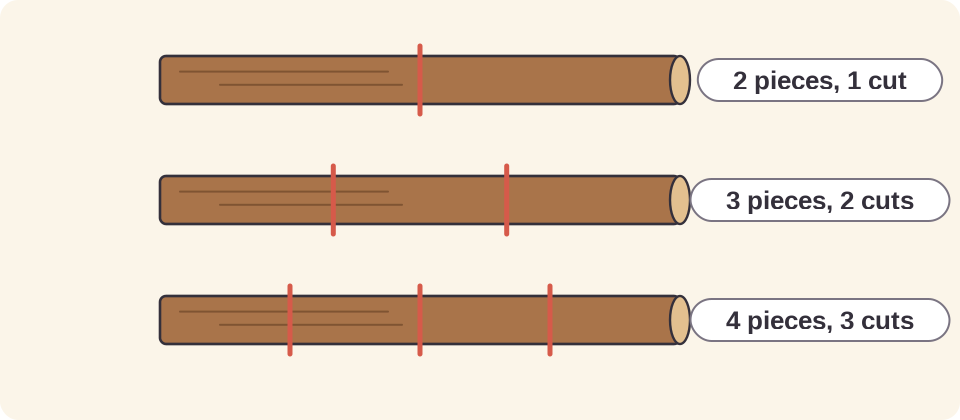
2 pieces need 1 cut. 3 pieces need 2 cuts. 4 pieces need 3 cuts.
Do you see it? The cuts are always one less than the pieces.
So 10 pieces need 9 cuts, not 10.
Your turn
A fence has 6 posts in a straight row, 1 meter apart. How long is the fence?
Try 2 posts: 1 gap, 1 meter. Try 3 posts: 2 gaps, 2 meters.
So 6 posts have 5 gaps. The fence is 5 meters long.
When a problem feels hard, ask: what would it look like with smaller numbers?
Try it at home
- Take a strip of paper and cut it into 3 pieces. Count the cuts.
- Try 4 and 5 pieces.
- Guess the cuts for 20 pieces without cutting.
Words in this lesson
- pattern - something that keeps happening the same way, so you can say what comes next.
Big idea
Try the problem with small numbers, find the pattern, then use it for the big ones.