Same Area, Different Perimeter
Grace has 12 square tiles. She can lay them in one long row, or in 3 rows of 4. Both cover the same space. Do they need the same border?
Same squares, different edges
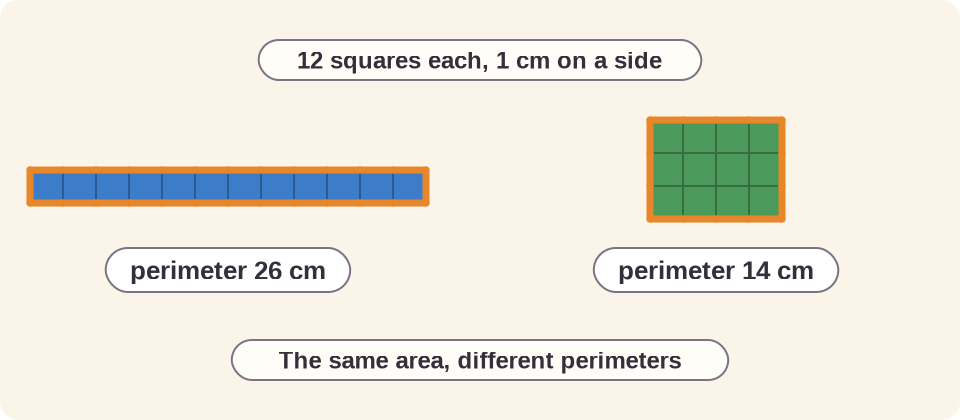
Both shapes are made of 12 squares, so their areas are the same.
One row of 12 squares, each 1 cm: its perimeter is 12 + 1 + 12 + 1 = 26 cm.
3 rows of 4: its perimeter is 4 + 3 + 4 + 3 = 14 cm.
The long thin shape has a much longer way round.
Shapes with the same area can have different perimeters.
Same fence, different room
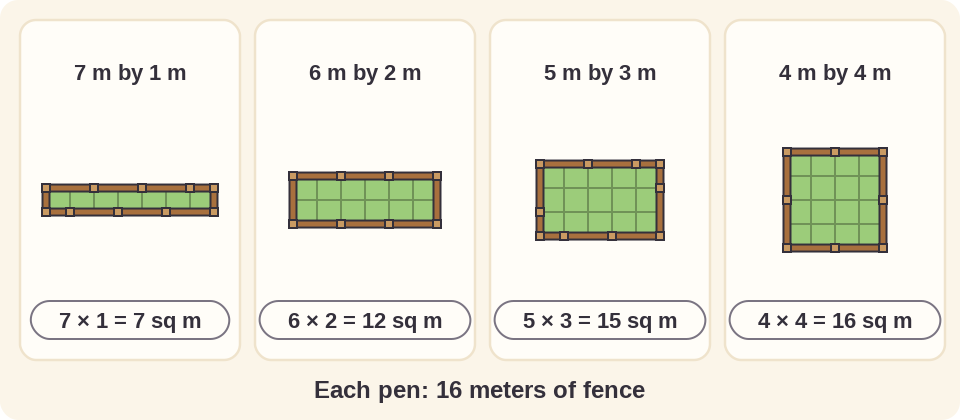
A farmer has 16 meters of fence for a rectangular pen.
7 by 1 holds 7 m². 6 by 2 holds 12 m². 5 by 3 holds 15 m².
4 by 4, a square, holds 16 m². That is the most!
The same fence can close off different areas. The squarest shape holds the most.
Try it at home
- Tie a string 16 inches long into a loop.
- Hold it on squared paper as a long thin rectangle, then as a square.
- Count the squares inside each. Which held more?
Words in this lesson
- pen - a fenced space where animals are kept.
Big idea
Area and perimeter are different: the same area can have different perimeters, and the same fence can hold different areas.