Why the Pod Had to Exist
You've already met the Pod — you saw one get created in the last lesson, wrapping your nginx container. But so far it's just looked like unnecessary paperwork: why wrap a container in something else at all? Why not just run containers and be done with it?
Here's the problem that made the Pod necessary.
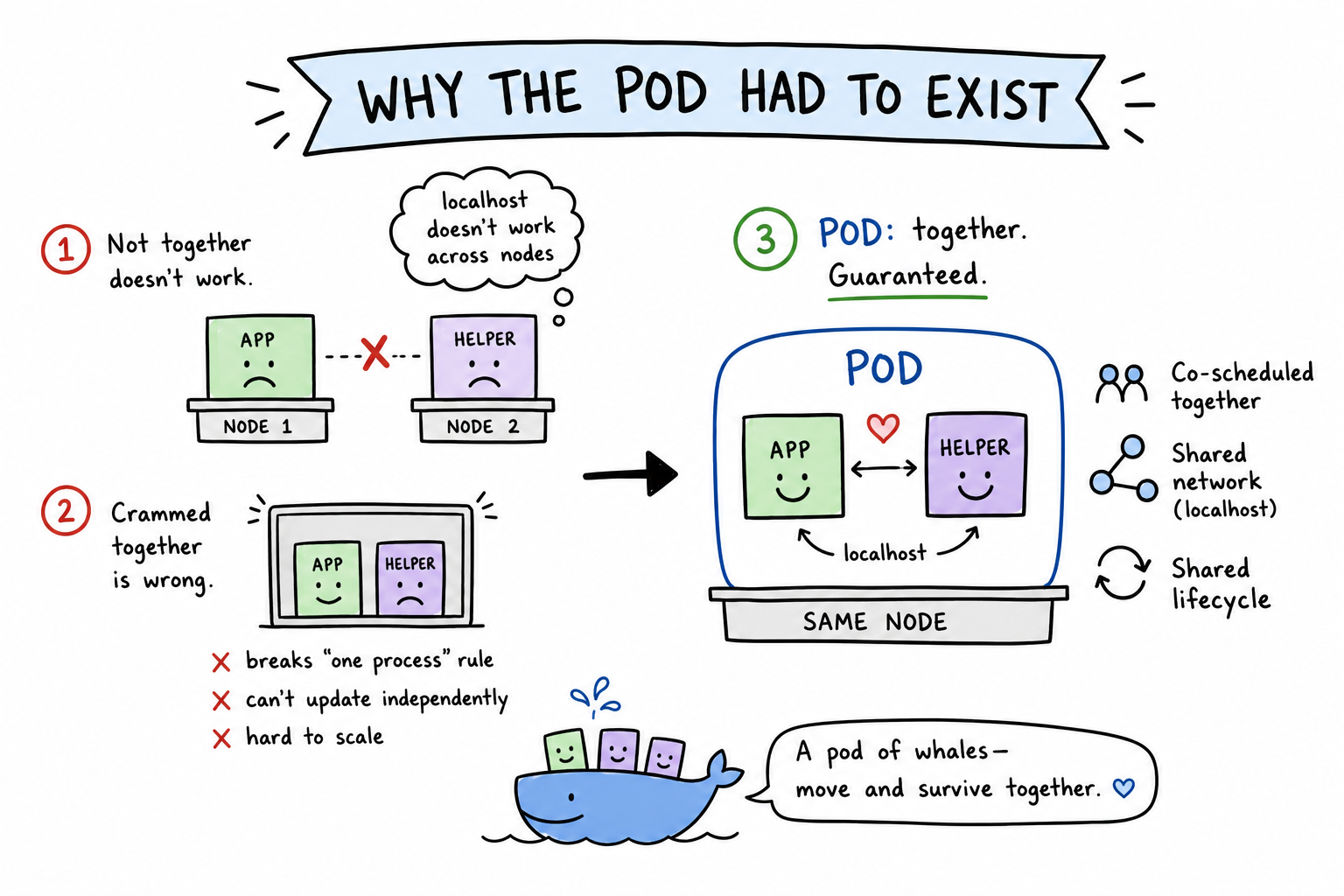
Say you're running a web app, and you also want a small helper process next to it — something that ships its logs somewhere, or watches a file and reloads config when it changes. Nothing fancy. But these two processes need to be close: they need to talk to each other over localhost, and if one goes down, you want them to go down and come back together, not drift out of sync.
First attempt: cram both processes into one container. One image, one entrypoint script that starts both. It works, technically — but now you've got a container that violates basically every rule you just learned about containers. One process per container was the whole point. Now you can't update the logging helper without rebuilding and redeploying your entire app image. You can't scale them independently. Your "container" is really two programs wearing a trench coat.
So, second attempt: split them into two separate containers, and just hope the scheduler puts them on the same machine. This mostly works — until the one day it doesn't. Your cluster gets busier, the scheduler makes a different call, and your app container and your logging container end up on two different nodes. localhost doesn't mean the same machine anymore. The two processes that were supposed to be talking to each other are now separated by a network they don't know exists.
What was actually needed wasn't "please schedule these near each other" — that's a request, and requests get denied when the cluster's busy. What was needed was a guarantee: these containers are inseparable, scheduled together or not at all, sharing a network address so they can reach each other over localhost no matter what else is happening on the cluster.
That guarantee is the Pod. Not a fancier container — a promise the scheduler is willing to keep.
This wasn't a hypothetical
This isn't just a plausible-sounding story — it's roughly what happened. Kubernetes wasn't Google's first attempt at this problem. Years before Kubernetes existed, Google was running a system internally called Borg, and Borg had the same tightly-coupled-processes problem you just walked through. Its answer was a grouping called an "alloc" — short for resource allocation — which co-scheduled a handful of containers together for exactly the sidecar-logging, cache-warming kind of setup described above.
Brian Grant, who worked on Borg and later became Kubernetes' design lead, has written that the team debated something you might expect: whether to skip all this and just let each Pod hold exactly one container, the way a lot of container tooling at the time assumed you would. They decided against it — keeping the one-app-per-container discipline inside each container, while still letting a Pod hold more than one when the situation genuinely called for it, which is why your containers field is a list even though you've only ever put one thing in it.
The name itself is a small piece of that same thinking: a Pod, as in a pod of whales — a group that moves and survives together, not a single animal with a fancier name.
See the guarantee in your own Pod
Your hello-web Pod only has one container in it, so this guarantee is invisible right now — there's nothing else in there to keep a promise about. But the promise is built into the Pod's shape either way. Check it yourself:
kubectl get pod hello-web-7d9f8c9d6b-x2k4p -o yamlLook for the containers: field in the output.
Output:
spec:
  containers:
  - image: nginx
    name: hello-web
...Notice containers is plural, and its value is a list — even though you only put one thing in it. That's not an accident of the YAML format. A Pod's spec was built from day one to hold more than one container, sharing that same network address and being scheduled as one inseparable unit. You're just not using that capacity yet.
The formal shape
A Pod guarantees three things about everything inside it:
- Co-scheduling — every container in a Pod lands on the same node, together, or the Pod doesn't run at all.
- Shared network — every container in a Pod shares one IP address and can reach each other over
localhost. - Shared lifecycle — the containers in a Pod start, stop, and restart as a unit, not independently.
Most Pods, like yours, only need that guarantee for one container — which is exactly why it's easy to forget the guarantee exists at all. It's only when you add a second container that you'd actually notice the difference between "these are running near each other" and "these are running together, guaranteed."
Takeaways
- The Pod exists to solve a specific problem: tightly coupled containers need a guarantee that they'll be scheduled together and share a network — not just a hope that the scheduler happens to place them nearby.
- A Pod's
containersfield is a list even when you only use one slot. The Pod was designed to hold more from the start. - Three guarantees define a Pod: containers inside it are co-scheduled, share a network address, and share a lifecycle.
- This isn't a made-up scenario — Google's earlier system, Borg, solved the same problem with a grouping called an "alloc," and the team behind Kubernetes carried that lesson forward deliberately when they designed the Pod.