The Pod Nobody's Watching
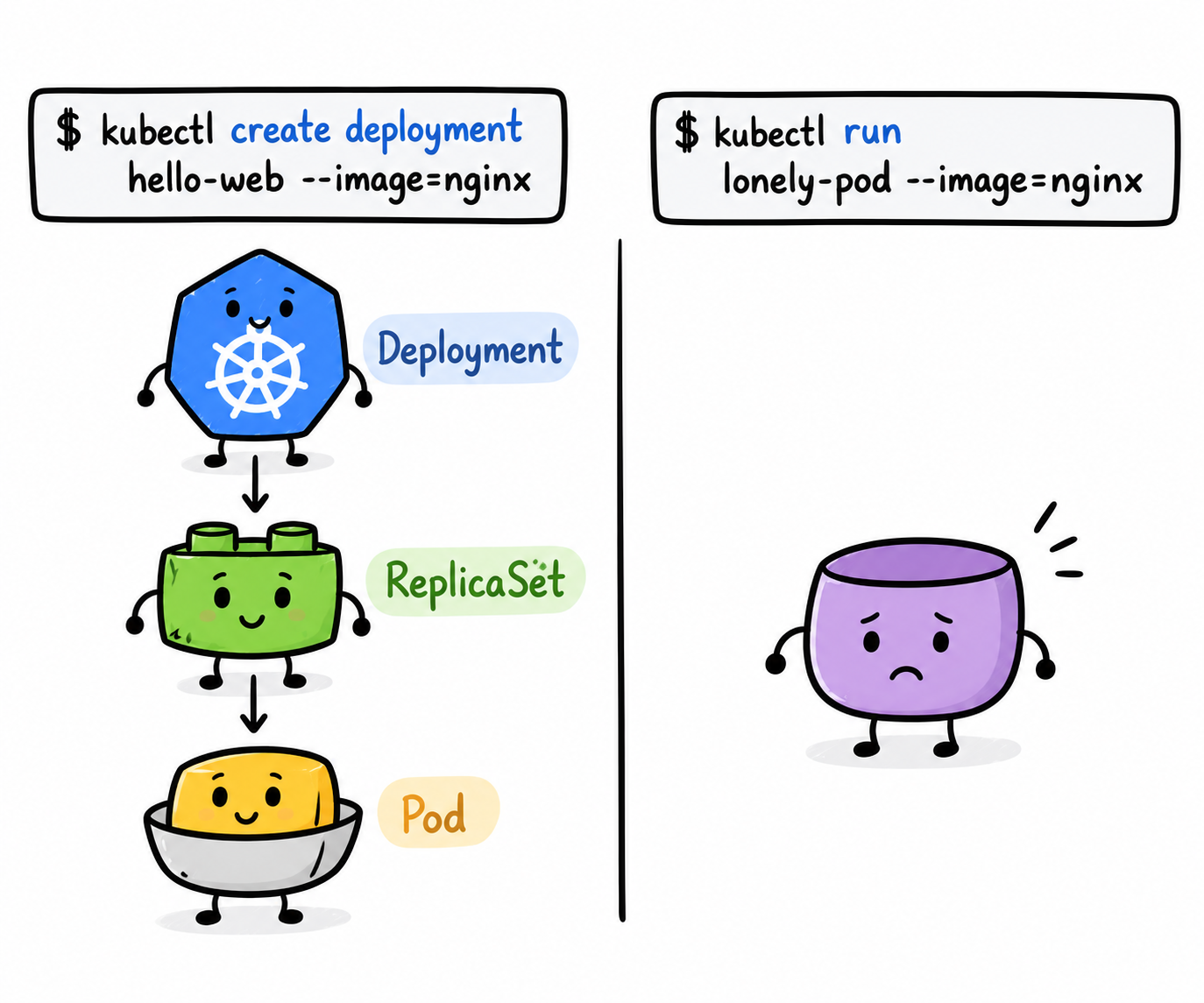
There's another command that creates something running on your cluster: kubectl run. It looks like a cousin of kubectl create deployment — similar syntax, same --image flag, same kind of result on screen. You might think it's just a shortcut for kubectl create deployment — fewer keystrokes, same result. That's a reasonable guess; both commands end with a Pod running your container, and both feel equally "correct" the first time you type them. But they don't create the same thing. kubectl create deployment creates a Deployment, which creates a ReplicaSet, which creates a Pod — the chain you saw back when you ran kubectl get all. kubectl run skips all of that and creates a bare Pod, directly, with nothing behind it.
That difference sounds small right now. It isn't. It's the difference between a Pod something is watching over, and a Pod that's entirely on its own.
Try it yourself
Create a second Pod, this time with kubectl run:
kubectl run lonely-pod --image=nginxNow check what actually got created:
kubectl get allOutput:
NAME                             READY   UP-TO-DATE   AVAILABLE   AGE
deployment.apps/hello-web        1/1     1            1           25m

NAME                                        DESIRED   CURRENT   READY   AGE
replicaset.apps/hello-web-7d9f8c9d6b        1         1         1       25m

NAME                                READY   STATUS    RESTARTS   AGE
pod/hello-web-7d9f8c9d6b-x2k4p      1/1     Running   0          25m
pod/lonely-pod 1/1 Running 0 8sLook closely at lonely-pod. Unlike hello-web-7d9f8c9d6b-x2k4p, its name has no random suffix tacked onto it — because nothing generated it from a template. There's no ReplicaSet above it, and no Deployment above that. It showed up in the Pod list and nowhere else. Compare that to the three-layer chain sitting right above it for hello-web, created by one call to kubectl create deployment back in the last lesson.
Same kind of object. Completely different amount of company.
Why this matters
A Deployment doesn't just create a Pod once and walk away — it keeps watching. If that Pod disappears, the Deployment (through its ReplicaSet) notices and creates a replacement. lonely-pod has no Deployment, so it has no one watching. If it disappears, it just… disappears. Nothing is checking whether it's supposed to still be there.
Right now, lonely-pod is sitting there running, indistinguishable from hello-web's Pod if you only look at kubectl get pods. Both say Running. Both look equally healthy.
Takeaways
kubectl runandkubectl create deploymentboth produce a running Pod, but they are not shortcuts for each other.kubectl create deploymentbuilds the full chain: Deployment → ReplicaSet → Pod.kubectl runcreates a bare Pod with nothing above it.- A bare Pod looks identical to a Deployment-managed Pod in
kubectl get pods— the difference only shows up inkubectl get all, where you can see what (if anything) owns it. - "Nothing owns this Pod" isn't a technicality. It determines what happens next if the Pod ever goes away.