Order Words for Empahsis
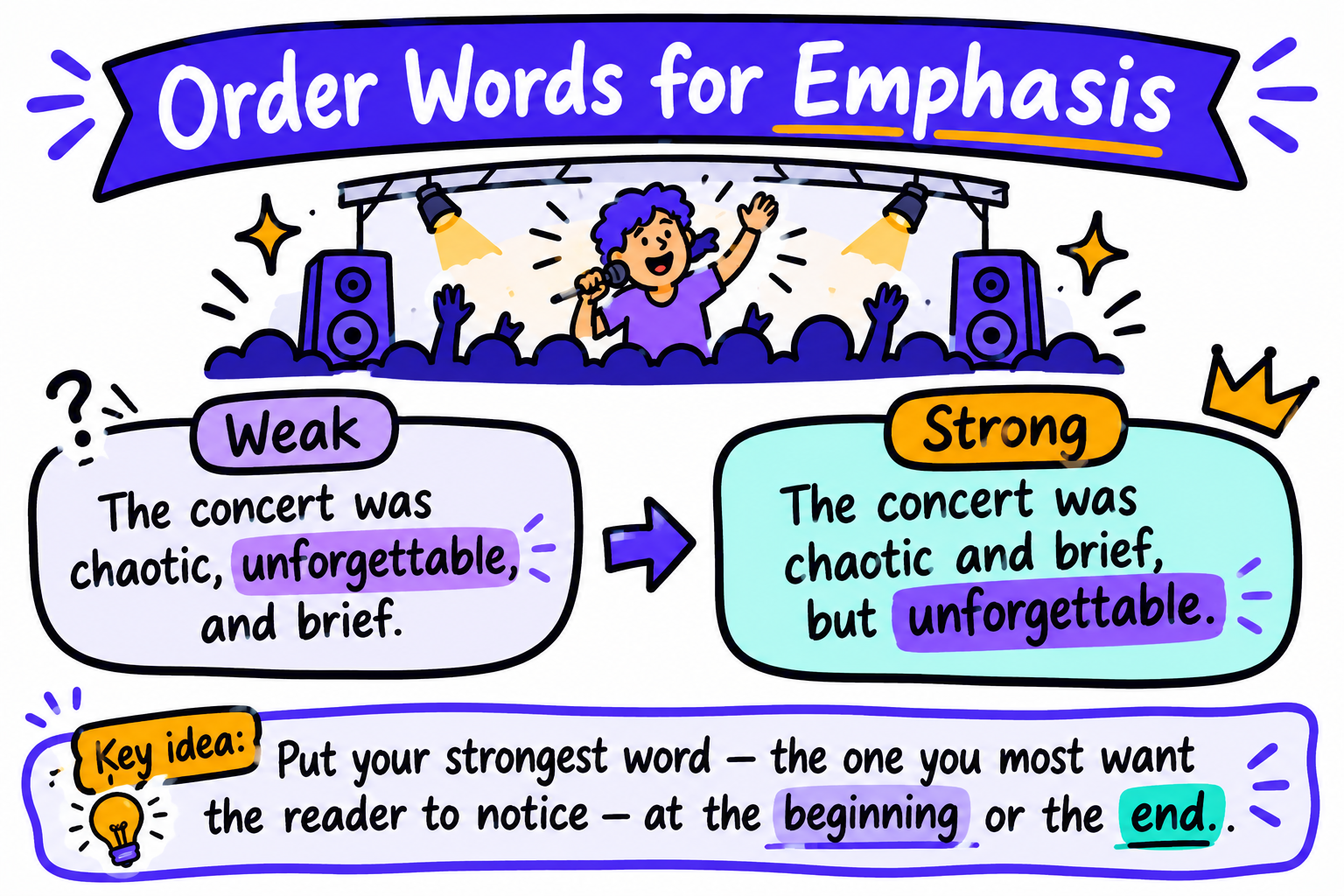
You might think that putting your key point at the start of a sentence is enough — you said the important thing, job done. That's a reasonable idea, and it's only half right. Readers also remember the last thing they read more strongly than what came in the middle. So if you place your best word up front and then let the sentence trail off with something weak, you've spent your strongest word too early and let the sentence end on nothing. The beginning and the end of a sentence are both strong positions. The middle is where words go to be ignored.
Where this idea comes from
This isn't only a writing rule — it started as a speaking rule. Public speakers, long before anyone wrote essays about sentence structure, had a real problem: a listener cannot go back and re-read a sentence. Once a spoken sentence is over, it's gone. If the most important word was buried in the middle, the audience may have already stopped paying close attention by the time it arrived, or they simply forgot it a few seconds later. Speakers learned, through practice and trial and error, that the words at the very start and the very end of a sentence are the ones a listener's ear catches and holds onto. So they built their strongest words, their sharpest phrases, and their key ideas around those two positions. Writers later borrowed the same habit, because it turns out readers' minds work the same way, even though they technically could go back and re-read.
The main idea
A sentence has two strong positions: the beginning and the end. Whatever you most want the reader to notice — your strongest word, your sharpest detail, your most important fact — belongs at one of those two edges. The middle of a sentence is where less important words can safely sit, because that's the part readers pay the least attention to.
Weak (strong word buried in the middle):
The concert was chaotic, unforgettable, and brief.
Strong (strong word at the end)
The concert was chaotic and brief, but unforgettable.
Same three words. Only the order changed. In the first version, "unforgettable" sits between two ordinary words and gets treated like just another item in a list. In the second version, it gets the last position all to itself, right where the sentence's energy naturally lands — and the small word "but" sets up a turn, which makes the ending word do even more work.
An important detail: the end position doesn't help by itself
Here's a common mistake. A writer might think: "I'll just put my sentence's most important word last, and it will automatically feel strong." But the ending position only works if you actually choose a strong word to put there. A sentence that trails off with something weak — "...which nobody really expected, to be honest" — wastes the position even though something technically sits at the end.
Try another comparison:
Weak (strong word buried in the middle):
I felt nervous, excited, and terrified walking into that interview.
Strong (strong word at the start):
Terrified, nervous, and excited — I walked into that interview.
Here, the strongest emotion moves to the very front, so it's the first thing the reader feels, before any of the calmer words that follow. Notice this works even though the sentence keeps the same three words — only the order changed.
Seeing it in a longer example
I was listening to his argument, shocked by how much knowledge he had.
Here, "shocked" — the strongest word, the actual emotion — is buried in the middle of the sentence, after "argument." Compare it with the word moved to the front:
Shocked by how much knowledge he had, I listened to his argument.
The second version hits harder immediately, because the reader feels the emotion first, before anything else. The information hasn't changed. Only the order has.
The rule, stated simply
Put your strongest word — the one you most want the reader to feel or remember — at the beginning or the end of the sentence. Let weaker, less important words sit in the middle, where they won't distract from the point you're actually trying to make.
Exercise
For each sentence below, find the strongest word and move it to the beginning or the end. Keep all the same words — only change the order.
- The trip was long, exhausting, but ultimately worth it.
- She answered the question calmly, confidently, and correctly.
- He walked into the room nervous, hopeful, and finally ready.
Show answer
Sentence 1, rewritten
The trip was long and exhausting, but ultimately worth it.
("Worth it" is already close to the end — this version simply tightens the sentence so it lands more clearly on that final phrase.)
Sentence 2, rewritten
Confidently, calmly, and correctly, she answered the question.
(Moving "confidently" — arguably the strongest of the three words — to the very front changes the entire feeling of the sentence before the reader even reaches the verb.)
Sentence 3, rewritten
Nervous and hopeful, he walked into the room, finally ready.
("Finally ready" carries the most forward motion, so it becomes the closing beat of the sentence instead of getting lost between two other adjectives.)
There's often more than one good answer here — the goal is simply to notice which word carries the most weight, and to make sure it isn't hiding in the middle.
Source: Tool #2 from Writing Tools by Roy Peter Clark.