Begin Sentences with Subjects and Verbs
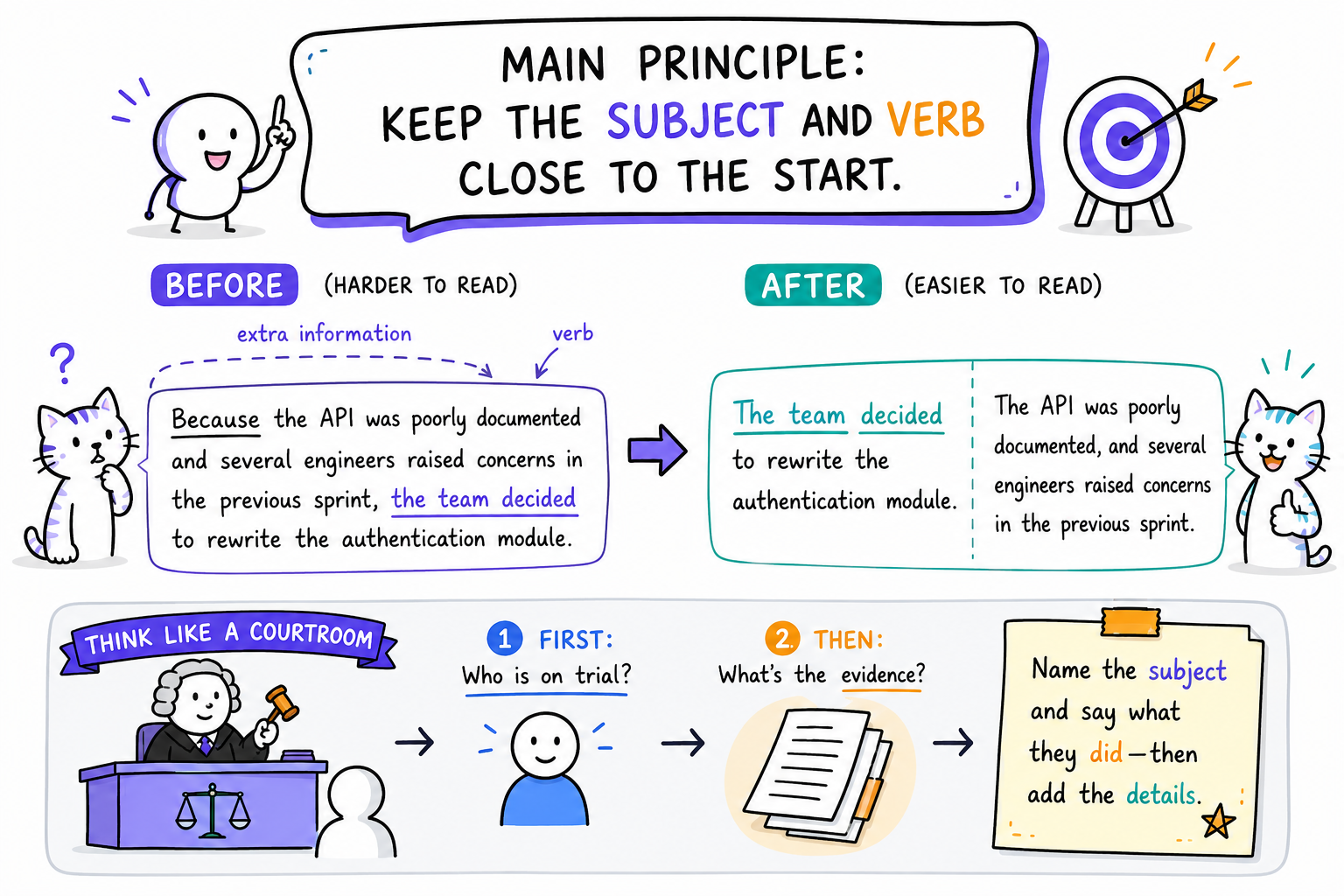
You might think that starting every sentence with its subject makes your writing sound flat, or even boring. "The team decided." "She sighed." It sounds like a police report, and a teacher probably told you to avoid this. That fear makes sense — many writers, trying to avoid it, build long sentences with extra clauses, hoping to sound smarter. But starting with the subject isn't about sounding simple. It's about order. A reader's mind works like a courtroom: it wants to know who is on trial before it hears the evidence. If you hide the subject and verb, you're showing the evidence before you've named the person on trial.
Where this idea comes from
This isn't a rule from a grammar book, made up for no reason. It comes from newspaper writing. Reporters worked under deadlines and had limited space in the newspaper. A story might get cut short without warning, so the most important information had to appear in the first sentence — sometimes the only sentence a reader (or a busy editor) would actually read. This pressure created a habit: say who did what right away, then add the extra details after. The habit stayed useful even after the deadlines were gone. It turns out readers everywhere want the same thing — not because they're in a hurry, but because a sentence with its subject and verb near the front is simply easier to follow.
The main idea
Readers find the core meaning of a sentence at its subject and verb. Put them close to the start, and the reader knows right away who did what. Everything else — extra details, examples, side information — is less important. It can safely come later in the sentence without confusing anyone, because the main point is already clear.
Weak (subject and verb hidden)
Because the API had been poorly documented and several engineers had raised concerns in the previous sprint, the team decided to rewrite the authentication module.
Strong (subject and verb up front):
The team decided to rewrite the authentication module. The API had been poorly documented, and several engineers had raised concerns the previous sprint.
The second version isn't shorter — it's clearer. You know right away who did what. The reasons come after, instead of delaying the main point.
An important detail: it's subject and verb, not just subject
Here's where people get this rule wrong. Writers hear "start with the subject" and stop there. But a sentence can start with its subject and still hide the verb behind a long piece of extra information in the middle. This causes the same problem as hiding both.
Her teammates, who had been debugging the same issue from a completely different angle, groaned when she posted the one-line fix.
The subject — "Her teammates" — is right at the start, in the first two words. But the verb, "groaned," doesn't appear until after a long piece of extra information in the middle finishes. The reader has to hold "Her teammates..." in mind, waiting, while a whole side-story about a different approach to debugging plays out — before the sentence finally tells them what the teammates actually did. An early subject doesn't help if the verb is still far away.
Seeing it in a full paragraph
The engineer stared at the failing test for twenty minutes before noticing the bug. A single misplaced semicolon, buried deep in a configuration file nobody had touched in months, had quietly broken the entire deployment pipeline. She sighed, fixed it, and pushed the change. The build passed on the first try. Her teammates, who had been debugging the same issue from a completely different angle, groaned when she posted the one-line fix in the group chat.
Let's look at each sentence:
| # | Subject | Verb | Subject + verb close together, near the start? |
|---|---|---|---|
| 1 | The engineer | stared | Yes |
| 2 | A single misplaced semicolon | had (quietly) broken | Subject is early, but the verb is delayed by extra information in the middle |
| 3 | She | sighed, fixed, pushed | Yes |
| 4 | The build | passed | Yes |
| 5 (main clause) | Her teammates | groaned | Subject is early, but the verb is delayed by extra information in the middle |
| 5 (extra clause) | she | posted | Yes |
Sentences 1, 3, and 4 are easy to read — the subject and verb sit close together, so the meaning becomes clear fast. Sentences 2 and 5 are noticeably harder to read the first time, even though both start with an early subject. What's missing near the start is the verb. That's the real problem this rule is warning you about — not "start with the subject," but "keep the subject and verb close together, near the start."
The rule, stated simply
Begin sentences with subjects and verbs, and keep the two close together. Say the main idea early. Let the extra details — side clauses, examples, conditions — come later, after the reader already knows who did what.
Exercise
Rewrite sentences 2 and 5 from the paragraph above so the verb sits closer to the subject. Move the extra information to a different part of the sentence — for example, to the end — without losing any information.
Show answer
Sentence 2, rewritten:
A single misplaced semicolon had quietly broken the entire deployment pipeline. It was buried deep in a configuration file that nobody had touched in months.
The subject and verb ("A single misplaced semicolon had... broken") now sit together at the start. The extra detail about the configuration file becomes its own sentence, using "It" so the idea isn't lost.
Sentence 5, rewritten
Her teammates groaned when she posted the one-line fix. They had been debugging the same issue from a completely different angle.
The subject and verb ("Her teammates groaned") now sit together at the start. The side information about the different debugging approach becomes its own sentence, right after.
Notice the pattern: in both cases, nothing was deleted — the extra information just moved out of the middle and into a sentence of its own.
Source: Tool #1 from Writing Tools by Roy Peter Clark.