Activate Your Verbs
First, three quick definitions
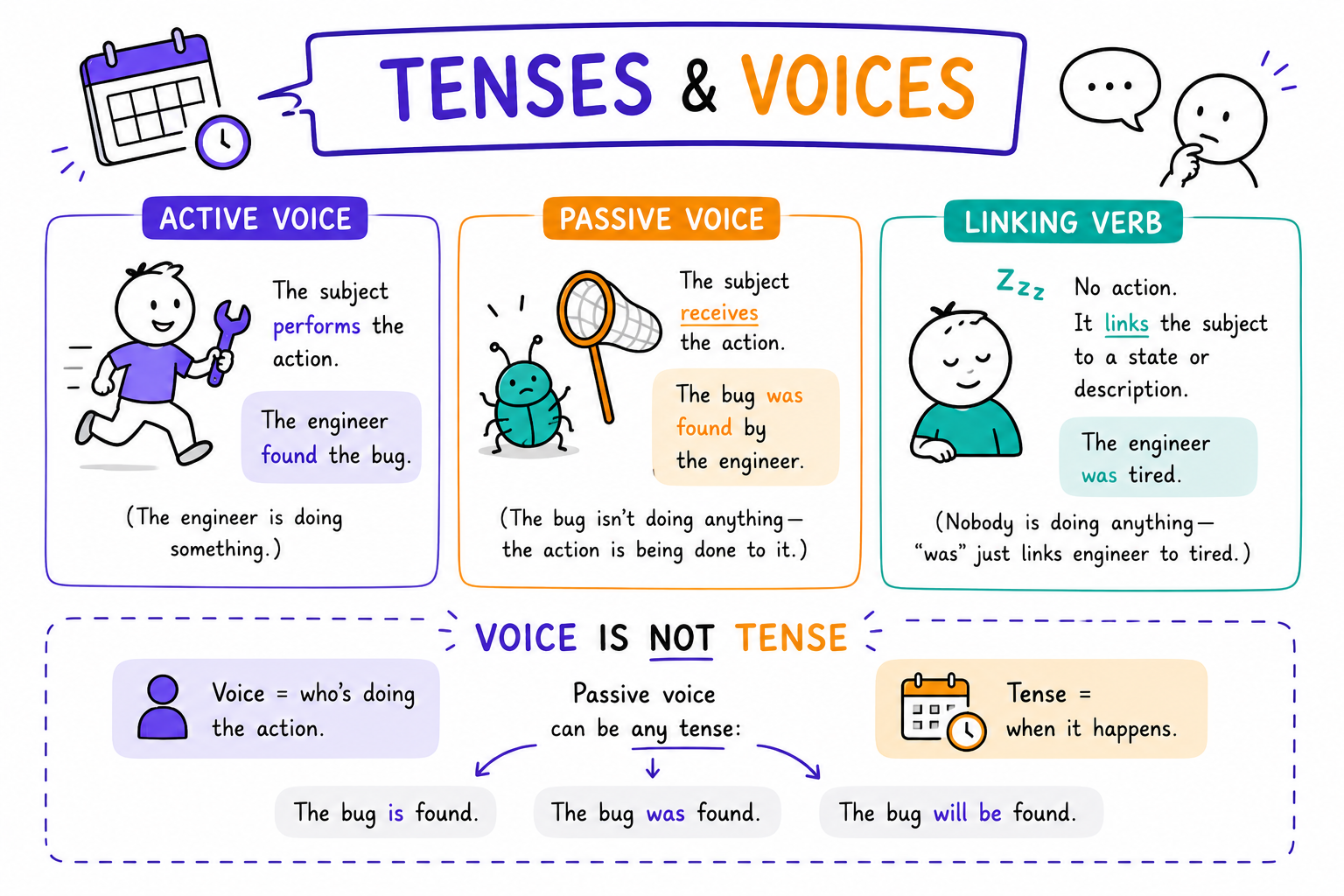
Before we get into the rule itself, it helps to be precise about what "voice" actually means, since it's often confused with tense.
- Active verb: the subject performs the action. The engineer found the bug. (The engineer is doing something.)
- Passive verb: the subject receives the action, instead of performing it. The bug was found by the engineer. (The bug isn't doing anything — the finding is being done to it.)
- Linking verb: no action at all. It just connects the subject to a description or state, usually with some form of "to be." The engineer was tired. (Nobody is doing anything here — "was" just links "engineer" to "tired.")
One important detail: voice and tense are two separate things. People often assume passive means past tense, because passive sentences often use past-tense helper words ("was found," "had been broken"). But passive voice can appear in any tense: "The bug is found" (present), "The bug will be found" (future). Voice is about who's doing the action. Tense is about when it happens. Don't confuse the two.
Now that you know the terms — the common misunderstanding
You might think a sentence like "The bug had been found and the issue had been resolved" sounds more formal, more professional — like a report, not a casual text message. That's a reasonable guess, since a lot of official, academic, and corporate writing leans on exactly this kind of language, and readers grow up assuming that's what "serious" writing sounds like. But formal doesn't mean strong. "I found the bug and fixed the issue" says the same thing, in fewer words, and it actually sounds more confident — like someone who did the work and isn't afraid to say so.
Where this idea comes from
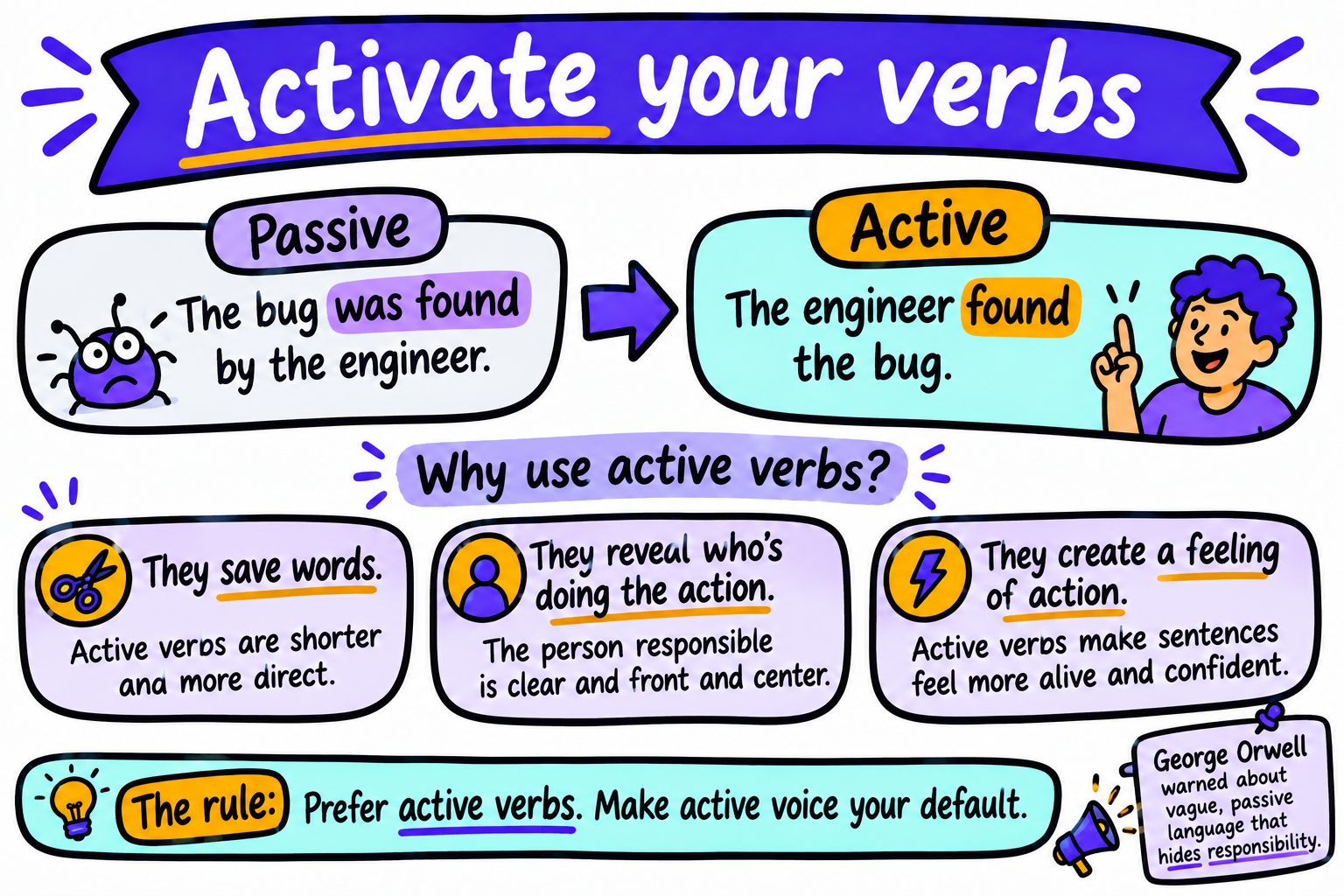
This idea has a real, well-known source outside of writing classes: the essayist George Orwell wrote about this exact problem, arguing that passive voice is one of the tools writers and politicians use — sometimes without realizing it — to avoid saying who did something. If a government report says "mistakes were made," the sentence never has to name who made them. The action appears in the sentence, but the person responsible quietly disappears. Orwell's worry wasn't really about grammar — it was about honesty. He noticed that vague, passive language often shows up exactly when someone doesn't want to take responsibility, or doesn't want the reader asking "who did this?" Writers since then have carried this same lesson into everyday writing: passive voice isn't wrong, but it deserves suspicion, because it's an easy way to quietly leave out the most important part of a sentence — the person who acted.
The main idea
Active verbs do three things passive verbs usually don't:
1. They save words.
Passive: The bug was found by the engineer. Active: The engineer found the bug.
"Was found by" takes three words to do the work that "found" does alone.
2. They reveal who's doing the action.
In the passive version, "the engineer" is pushed toward the end of the sentence, almost like an afterthought, tucked behind "by." In the active version, the engineer is the very first word — front and center, clearly the one doing something.
3. They create a feeling of action.
Read both versions out loud. "Was found" feels like something that simply happened to the bug. "Found" feels like something the engineer actually did. The active version has more energy, even though both sentences describe the exact same event.
The rule, stated simply
Prefer active verbs. They save words, name who's responsible for the action, and make sentences feel like something is actually happening. Make active voice your default.
Exercise
Rewrite each sentence below in active voice.
- The report was written by the intern over the weekend.
- The bridge was designed by a young engineer fresh out of school.
- Mistakes were made during the migration.
- The decision was announced by the CEO at the all-hands meeting.
Show answer
1. The intern wrote the report over the weekend.
2. A young engineer fresh out of school designed the bridge.
3. We made mistakes during the migration. (or name the specific team/person if known)
4. The CEO announced the decision at the all-hands meeting.
Notice what each rewrite does: it takes a person who was hiding at the end of the sentence, tucked behind "by" (or missing completely, as in sentence 3) and moves them to the front, where they belong. Every one of these active versions is shorter, clearer, and puts a real person in charge of the action.
Source: Tool #3 from Writing Tools by Roy Peter Clark. Clark's discussion draws on George Orwell's essay Politics and the English Language.*