How Long Is a Year?
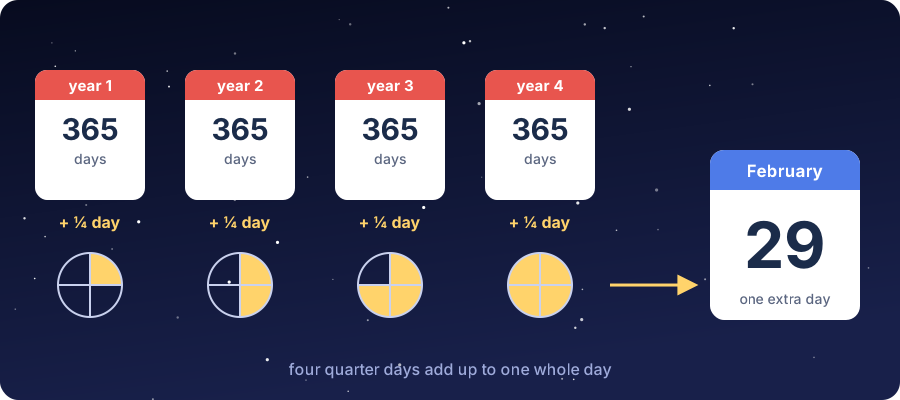
In Level 1 we saw that a year is one trip of the Earth around the Sun, about 365 and a quarter days, and that a leap day every four years soaks up the extra quarter. That is almost right. This lesson is about the "almost".
Not quite a quarter
Measured carefully, from one spring to the next, the year is about 365.2422 days: 365 days, 5 hours, 48 minutes and 45 seconds.
A quarter of a day is 6 hours. So a year is about 11 minutes shorter than 365 and a quarter days. A leap day every four years adds those 11 minutes on top, every single year.
The Julian calendar
In 46 BC, Julius Caesar set up a calendar for Rome with exactly the rule from Level 1: a leap day every four years, so the average year was 365.25 days.
Eleven minutes a year sounds like nothing. But it adds up: about one whole day every 128 years. By the 1500s the calendar had slipped about 10 days out of step with the seasons. The first day of spring, which should fall around 21 March, was arriving around 11 March.
The Gregorian fix
In 1582, Pope Gregory XIII brought in a new calendar, the one most of the world uses today. It did two things:
- It jumped 10 days. In the countries that switched at once, Thursday 4 October 1582 was followed by Friday 15 October.
- It changed the rule, so the drift wouldn't come back. A year divisible by 100 - a century year like 1700, 1800 or 1900 - skips its leap day, unless it is also divisible by 400, like 1600 or 2000.
That drops 3 leap days every 400 years: 97 leap years instead of 100. The average year becomes 365.2425 days, so close to the real year that the calendar drifts only about one day in 3,000 years.
Not every country switched in 1582. Britain and its colonies waited until 1752, and Russia until 1918.
Words to know
- Julian calendar - Julius Caesar's calendar, with a leap day every four years
- Gregorian calendar - the calendar used today, which skips the leap day in century years not divisible by 400
Big idea
The year is about 365.2422 days. A leap day every four years overshoots, so century years skip it - unless they are divisible by 400.